
Table of Contents
- Why Coaches Need More Than a Basic CPR Certificate
- HLTAID011 Provide First Aid Requirements for Coaches
- Coaching-Specific Injury Scenarios and Legal Liability
- First Aid Certification Validity Period and Renewal for Sports Organisations
- First Aid Training for Sports Clubs: Choosing the Right Provider
- Course Duration, Delivery Methods, and Cost Transparency
- Conclusion: Choosing the Best First Aid Certification for Your Club
- Frequently Asked Questions
Last Updated: October 4, 2026
Why Coaches Need More Than a Basic CPR Certificate
A CPR certificate alone will not meet your duty of care as a coach. When a player collapses, bleeds heavily, or suffers a suspected spinal injury, you need skills beyond chest compressions.
That is why the first aid certification you choose matters. The same gap often shows up: coaches hold a CPR unit, then discover it does not cover bleeding control, fracture management, or casualty assessment.
Here is the short version before we go further:
- CPR training alone covers one emergency. First aid training covers dozens.
- Most sports organisations require the full HLTAID011 Provide First Aid unit.
- Your certificate expires, and renewing late puts your club’s insurance at risk.
Below, we break down which units coaches need, how long certification lasts, and how to pick a provider that delivers practical, hands-on training.
HLTAID011 Provide First Aid Requirements for Coaches
HLTAID011 Provide First Aid is the minimum nationally recognised unit for most sports coaches in Australia. It is the benchmark unit that clubs, insurers, and sporting bodies expect coaches and volunteers to hold.
The unit is delivered under the Australian Quality Training Framework, which means it must be taught by a registered training organisation and assessed through both theory and practical demonstration. You can read the official unit details through the national training register.
What the HLTAID011 Course Covers
The course teaches you how to respond to a casualty before an ambulance arrives. Core skills include:
- Casualty assessment and emergency response
- CPR and AED usage on adults, children, and infants
- Bleeding control and wound management
- Fracture, sprain, and strain management
- Head, neck, and spinal injury care
- Asthma, anaphylaxis, and seizure response
- Incident reporting and handover to paramedics
How HLTAID011 Compares to HLTAID009 and HLTAID012
Coaches often ask which unit is which. Here is the difference:
|
Unit |
What It Covers |
Best For |
|---|---|---|
|
HLTAID009 |
CPR only |
Annual CPR refresher |
|
HLTAID011 |
Full first aid + CPR |
Most coaches and volunteers |
|
HLTAID012 |
First aid in education and care settings |
Coaches working with young children |
For most community and school sports coaches, HLTAID011 is the right choice. If you work with early childhood groups, HLTAID012 adds the duty-of-care context you need.
Coaching-Specific Injury Scenarios and Legal Liability
The injuries seen on a field are not always those covered in a generic workplace course. Coaches deal with collisions, falls, heat stress, and overuse injuries, often with no medical staff nearby. A trainer who has never worked with sporting groups may not run scenarios for a suspected concussion, a dislocated shoulder, or an asthma attack triggered mid-game.
Sport-Specific Scenarios Worth Rehearsing
A useful way to pressure-test any course is to ask whether it rehearses the emergencies your code produces:
- Concussion and head knocks (contact codes): recognition using the concussion-in-sport assessment approach, immediate removal from play, and the return-to-play protocol. Coaches are usually the first person to make the call, not a medic.
- Lateral ankle sprains and knee injuries (netball, basketball, football): the RICER approach (rest, ice, compression, elevation, referral), when to splint, and when to stop the player returning.
- Heat stress and dehydration (cricket, athletics, summer sport): recognising heat exhaustion versus heat stroke, cooling methods, and when to call an ambulance rather than keep the player on the sideline.
- Asthma and anaphylaxis mid-game (all codes): reliever inhaler versus adrenaline autoinjector, positioning, and the fact that exercise is a common trigger.
- Severe bleeding and suspected fractures (rugby league, AFL, hockey): direct pressure, tourniquet awareness, and immobilisation before transport.
- Sudden cardiac arrest (all codes): CPR and AED use, including where the nearest AED is at your home ground, a detail worth confirming before the season starts, not during an incident.
Where the Legal Liability Actually Sits
Legal liability is the part most coaches miss. Under work health and safety law, anyone running an activity, including a volunteer coach, has a duty of care to the people in it. If a player is injured and you cannot show you held current, appropriate certification, your club’s insurance cover may be questioned. The Safe Work Australia guidance on duty of care sets out how this obligation applies to organisers of sporting activities.
Three practical points coaches tend to overlook:
- Certification currency is the first thing an insurer or investigator checks. A lapsed CPR refresher can undermine an otherwise defensible response.
- Incident documentation matters as much as the response. A written record of what you saw, what you did, and when you handed over to paramedics is part of your duty of care, not an optional extra.
- Your sport’s governing body policy sits on top of the general law. Many codes publish their own minimum first aid standard for coaches and officials, check that policy, because it can be stricter than the general duty of care.
First Aid Certification Validity Period and Renewal for Sports Organisations
First aid certification is valid for three years from the date of issue, but the CPR component must be renewed every 12 months. This is the most common compliance gap we see in sports clubs.
The three-year expiry applies to the full HLTAID011 unit. The CPR element inside it, drawn from HLTAID009, needs an annual refresher. Miss it and your first aid competency is technically out of date, even if your certificate still looks valid.
How Often Should Coaches Renew?
Use this as your renewal schedule:
- Every 12 months: CPR refresher (HLTAID009)
- Every 36 months: Full first aid requalification (HLTAID011)
- After any major incident: Consider a confidence refresher, even if not due
- When your sport’s governing body changes its policy: Check the new requirement
For clubs with volunteer coaches, stagger renewals across the season so you never have a game day where nobody on the sideline holds a current certificate.
First Aid Training for Sports Clubs: Choosing the Right Provider
First aid training for sports clubs works best when it comes to you. Mobile training means your whole coaching group trains together, on your schedule, in your club rooms.
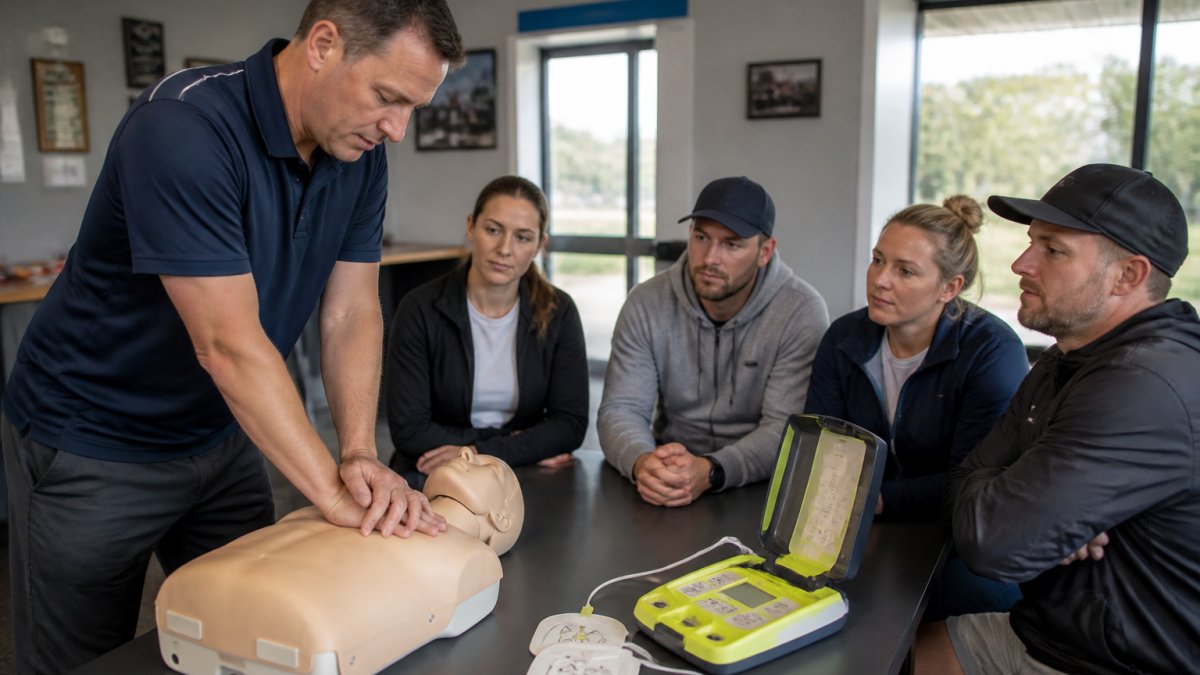
We bring the manikins, AED trainers, and bandages to your venue, so your coaches train where they actually work.
Match the Unit to the Coaching Role First
Before you compare providers, confirm which unit your coaches actually need. The right answer depends on the age group and setting, not just the sport:
|
Coaching context |
Unit to book |
Why |
|---|---|---|
|
Senior and adult community sport |
HLTAID011 Provide First Aid |
Covers CPR, bleeding, fractures, and casualty assessment in one nationally recognised unit |
|
Junior sport where you are the designated first aider |
HLTAID011 Provide First Aid |
Same coverage; the duty of care is higher, not lower, with minors |
|
Early childhood or school-based programs with very young children |
HLTAID012 First Aid in an Education and Care Setting |
Adds the education-and-care duty-of-care context that HLTAID011 does not |
|
Coaches who only need to maintain the CPR component |
HLTAID009 Provide CPR |
Annual refresher only; not sufficient as a standalone qualification for most coaching roles |
A provider who cannot explain this distinction is not the right provider. The unit choice drives course length, assessment, and renewal schedule, get it right before you book.
Accreditation and RTO Status
Any provider you consider must be a registered training organisation, or deliver on behalf of one. Ask for the RTO ID before you book. If a provider cannot give you one, walk away.
We deliver as a training partner of Healthcorp, RTO ID 91222. You can confirm any provider’s registration through the national register of training organisations.
Practical Assessment vs Online Theory
Online theory is fine for the knowledge component, but not enough on its own. Nationally recognised first aid units require a hands-on practical assessment, where you demonstrate CPR, bandaging, and casualty care on a manikin or partner.
Be sceptical of any course offering full certification with no in-person component. It will not meet the unit’s assessment requirements, and it will not prepare you for a real emergency.
Five Questions to Ask Before You Book
- Which unit will my coaches receive, and is it the right one for our age group? If the answer is vague, keep looking.
- Who delivers the practical assessment, and what are their credentials? The assessor should hold current first aid competency and be authorised by the RTO.
- Will the scenarios reflect our sport? A provider who runs the same script for every club is not tailoring anything.
- How is the certificate issued, and how will we track renewals? Ask whether the provider sends reminders before the 12-month CPR refresher falls due.
- What happens if a coach misses the practical session? A good provider has a catch-up pathway rather than making the whole group rebook.
Course Duration, Delivery Methods, and Cost Transparency
A full HLTAID011 course usually runs six to eight hours including breaks. Blended learning, where you complete theory online first, can cut face-to-face time to roughly three to four hours.
Delivery options to weigh up:
- Face-to-face, on-site: Best for teams. Everyone trains together, in your own venue.
- Blended learning: Online theory plus a short practical session. Good for busy coaches.
- Public courses: You travel to a venue and train alongside strangers. Workable for individuals, awkward for whole clubs.
Pricing depends on group size, location, and how many units you need. Call us for a quote and we will give you a clear figure up front, with no hidden extras.
Conclusion: Choosing the Best First Aid Certification for Your Club
The right certification comes down to three things: the correct unit, a current renewal schedule, and a provider who trains your coaches in realistic, sport-specific scenarios.
If you are weighing up the best first aid certification for coaches, start with HLTAID011, add the annual CPR refresher, and book a provider who comes to you.
Provide First Aid Gold Coast delivers mobile, hands-on training at your club, with all equipment supplied and trainers who have worked in real emergency settings. We are a training partner of Healthcorp (RTO ID 91222), and our courses are simple, practical, and easy to follow.
Call us to book your course and get your whole coaching group certified on site, on a date that suits your season.
Frequently Asked Questions
Do sports coaches need a specific first aid qualification?
Yes, coaches typically need a nationally recognised first aid certification. The most common requirement is HLTAID011 Provide First Aid, which covers CPR, casualty assessment, and emergency care skills. Some sports organisations may also require HLTAID012 for working with children. Check with your governing body for specific first aid training for sports clubs requirements.
How often should a coach renew their first aid certification?
HLTAID011 certification is valid for three years, but the CPR component must be renewed annually. This means coaches need to complete a refresher course every 12 months to maintain their first aid competency. Many sports organisations set their own renewal frequency requirements, so check your club’s policy for compliance.
What is the difference between HLTAID009 and HLTAID011 certificates?
HLTAID009 covers CPR only and is valid for 12 months. HLTAID011 Provide First Aid includes CPR plus broader emergency care skills like wound management, casualty assessment, and defibrillator training. For coaches, HLTAID011 is generally the minimum requirement because it prepares you for injuries beyond cardiac arrest, such as fractures and allergic reactions.
Can I complete first aid certification online?
You can complete the theory component online through blended learning, but practical assessment is mandatory for HLTAID011. You must demonstrate CPR and emergency response skills in person with an accredited trainer. Mobile training providers can deliver the practical assessment at your sports club, making it easier for volunteer coaches to complete certification together.
Recent Comments