
Last Updated: November 14, 2026
Quick Summary
Onsite CPR training brings a certified instructor and all the equipment needed to your workplace, so staff learn cardiopulmonary resuscitation where they actually work. Provide First Aid Gold Coast delivers this mobile training to your site, so your team can learn together on a timetable that suits operations.
- Aim for at least one trained responder on every shift, plus a backup for leave and turnover.
- Ask your provider how they will organise practice time for your group size before confirming numbers.
- Keep a coverage register with site, shift, course date and renewal date for every employee.
- Skills can fade before a certificate expires, so schedule short hands-on refreshers between full requalifications.
- Run quarterly unannounced drills and check AED charge, pad dates and location.
Table of Contents
- What Onsite CPR Training for Employees Involves
- How Many Employees Can Attend a Workplace Session
- CPR Training Duration and What Affects It
- Space, Equipment and Preparation for Your Workplace
- Group CPR Training Across Multiple Sites and Teams
- How Often Staff Need a CPR Refresher
- Booking Your Onsite CPR Course for Your Team
- Frequently Asked Questions
What Onsite CPR Training for Employees Involves
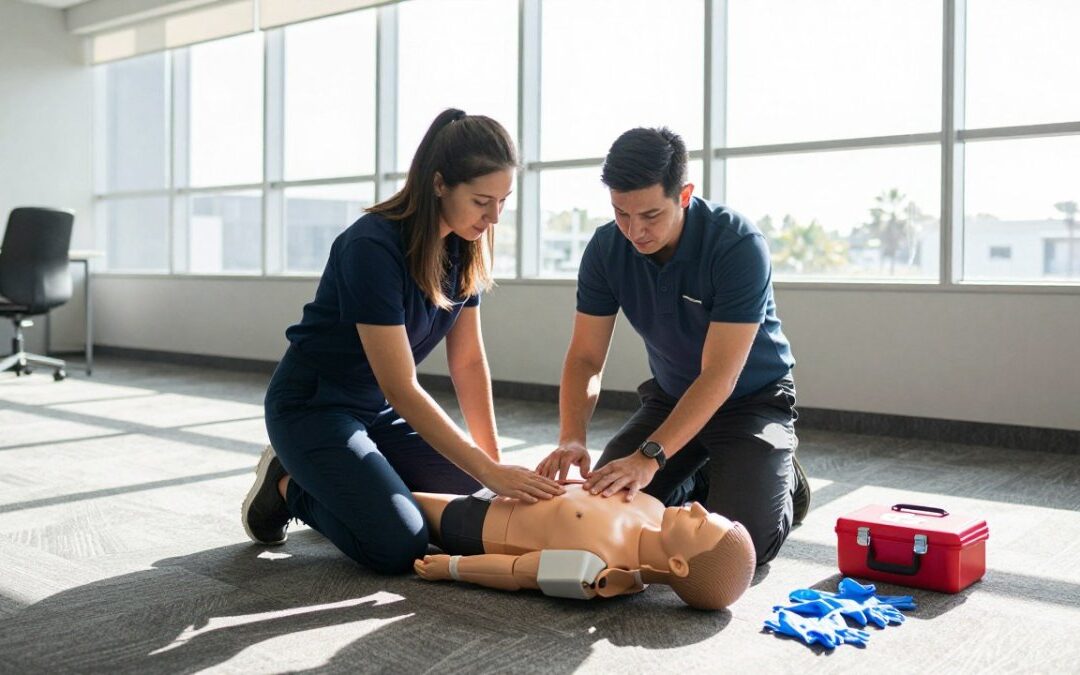
Onsite CPR training brings a certified instructor and all the equipment needed to your workplace, so your staff learn cardiopulmonary resuscitation in the place they actually work. Instead of sending people across town, the course runs in a break room, a training room or a warehouse floor, and it covers the skills needed to respond when a colleague collapses. Provide First Aid Gold Coast delivers mobile training to your site, bringing the necessary equipment with it.
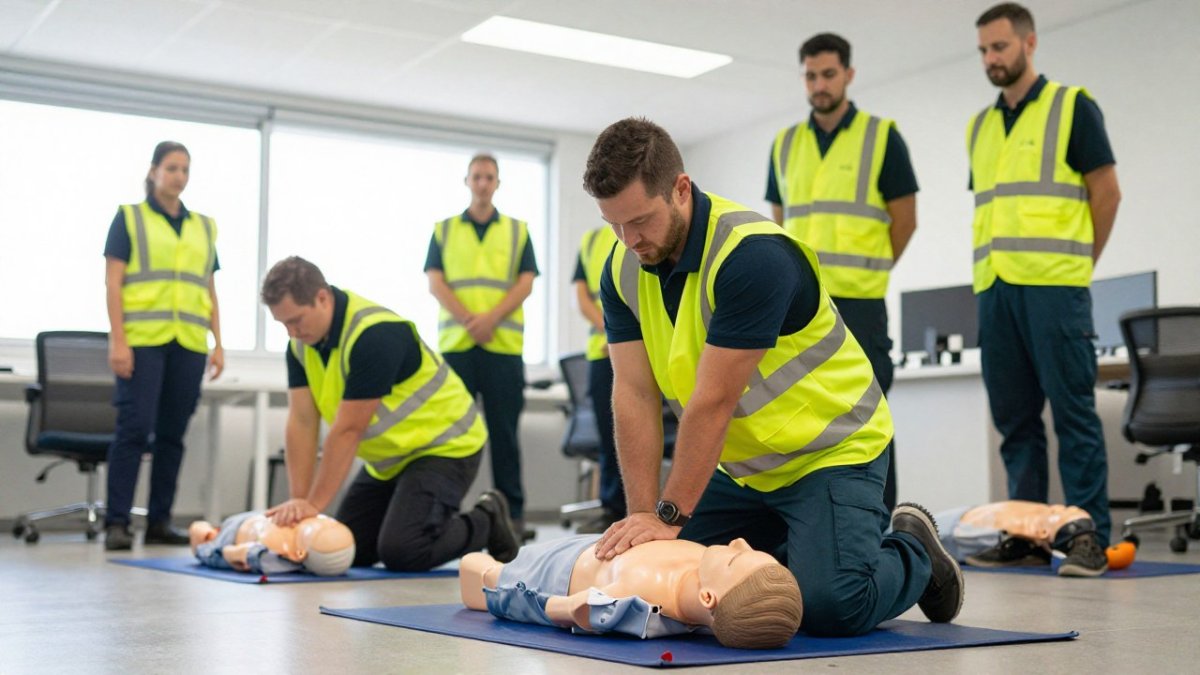
For most workplaces, the appeal is simple: the team trains together, in familiar surroundings, on a timetable that suits operations. A common mistake is treating onsite training as only a tick-box exercise. The real value comes when staff practise compressions and ventilations on a manikin under realistic pressure, then talk through what they would do on the job.
What happens during the session
Trainers keep the pace practical. Scenarios drawn from the workplace make the skills easier to recall, and staff get the chance to ask questions about their own sites.
How Many Employees Can Attend a Workplace Session
There is no single maximum, because the right group size depends on the number of manikins available, the size of the room and how long you want the session to take.
Ask your provider how they plan to organise the group before you confirm numbers.
Work out how many trained employees you actually need
Rather than starting from a course brochure, start from a coverage calculation. For each site, list the shifts you run, the minimum number of staff on the floor during each shift, and the roles that cannot leave an area unattended. A defensible plan usually aims for at least one trained responder on every shift, plus a second person as backup for leave, sickness and turnover. Where a site runs a single day shift with a small team, that may mean training three or four people; a 24-hour operation with four shifts may need eight to twelve to maintain cover.
Then test the plan against your hazards. A warehouse with forklifts, a commercial kitchen with hot oil and knives, and an office with low physical risk do not carry the same exposure, and the number of trained staff should reflect the likelihood of a cardiac arrest or serious injury and the time it takes an ambulance to reach the site. Remote or isolated sites generally warrant broader coverage because help is further away.
Session size and practice ratios
Ask the provider how they plan to organise practice time for your group before you confirm numbers.
A simple coverage register
Build a spreadsheet with one row per employee and columns for site, shift, role, course completed, completion date and renewal date. Sort by shift to see at a glance whether any shift has no trained responder. Update it after every session and review it quarterly so turnover does not quietly erode your cover.
CPR Training Duration and What Affects It
CPR training duration varies with the course level, the number of participants and whether the session includes AED instruction.
Ask for a clear timetable before booking so the session fits around shift patterns.
Space, Equipment and Preparation for Your Workplace
A workable training space needs enough open floor for participants to kneel safely beside a manikin, with room for the trainer to move between groups. A quiet room with a hard, level floor works best. Carpet can make compressions harder to practise accurately, so a mat or a clear area is useful if the floor is soft.
All training equipment is provided by the trainer, but you should confirm the details in advance. Clear the space before the session, make sure power is available if any equipment needs it, and tell staff the session is scheduled so that people on shift can be released without disruption.
Group CPR Training Across Multiple Sites and Teams
Organisations with several sites or teams can often run training at each location on separate dates, or schedule sessions to cover staff on different shifts. Grouping staff by site keeps travel down and makes it easier for the trainer to tailor scenarios to each workplace.
Coordination is the main challenge. Keep one list of who has attended, which sites are covered and which staff still need training. This avoids the situation where a site is missed or the same people are trained twice.
How Often Staff Need a CPR Refresher
CPR skills fade without regular practice, so most workplaces plan refresher training at regular intervals rather than treating the initial course as a one-off. The right interval depends on your industry, your obligations and the training provider’s certification period, so check the certificate details for each participant.
Track the expiry date for every certificate in one place. A simple register showing each person’s completion date and renewal date makes it easy to book the next session before anyone’s certificate lapses.
Certificate validity versus skills currency
These are two different things and both matter. The certificate has a stated validity period set by the awarding body, and that is the date your compliance records must respect. Skills currency is about whether a person could still perform effective compressions today, and it can decay well before the certificate expires. Many workplaces therefore schedule a short skills refresher between full requalifications, a 30- to 60-minute hands-on session on manikins, so staff rehearse compressions and AED use without waiting for the full course cycle.
Plan the renewal calendar backwards
Work backwards from each certificate’s expiry date. If a certificate is valid for a set period, book the requalification session several weeks before expiry so there is room for rescheduling without a lapse. Group renewals by site and shift so you are not running a separate session for one or two people. Where turnover is high, consider training new starters within their first weeks rather than waiting for the next group intake.
Watch out: relying on a single spreadsheet maintained by one person is a common failure point, if that person leaves, renewal dates get missed, so keep the register in a shared system with a named backup owner.
Measure whether the training worked
Booking the course is the start, not the end. A short follow-up checklist turns training into capability:
- Run a quarterly unannounced drill: ask a staff member to talk through and demonstrate the response to a collapsed colleague, including calling for help and retrieving the AED.
- Check AED accessibility: confirm the device is charged, pads are in date, and staff know exactly where it is and how to retrieve it.
- Review coverage by shift after any roster change, and flag shifts with no trained responder.
- Record attendance, assessment outcomes and refresher dates in the same register so an inspector or insurer can see a clear trail.
- Ask staff after each drill what felt unclear, and feed those gaps into the next refresher session.
This follow-up loop is where most onsite programmes are weakest, and it is the part that demonstrates genuine emergency preparedness rather than a completed booking.
The table below sets out the key points about keeping CPR skills current and tracking renewals.
| Item | Point | Note |
|---|---|---|
| Certificate validity | Set by the awarding body | Compliance dates must respect this |
| Skills currency | Can decay before expiry | Shorter refreshers help keep skills sharp |
| Skills refresher length | 30 to 60 minutes | Hands-on practice on manikins |
| Renewal planning | Book several weeks before expiry | Allows rescheduling without a lapse |
| Register owner | Keep a named backup | Avoids missed renewal dates |
| Drill frequency | Quarterly | Unannounced, tests real response |
Booking Your Onsite CPR Course for Your Team
To book, start by listing the number of staff, the sites involved and the dates that suit your operations. Then contact Provide First Aid Gold Coast to discuss your requirements. Pricing depends on group size, the number of sessions and the delivery schedule, so request a quote for your specific team. Call the team to book your course.
Call Provide First Aid Gold Coast today to book your onsite CPR course for your team and get your staff ready to respond with confidence. Our trainers bring all the equipment to your site, and we will work with you on timing that fits your roster.
Australian Resuscitation Council guidelines on CPR
Frequently Asked Questions
What happens during onsite CPR training for employees?
A trainer attends your workplace with all training equipment, so staff do not need to travel.
How many employees can attend a workplace CPR training session?
Group CPR training works well for teams of varying sizes, and the number of participants affects how long the session runs and how many trainers are needed. Group size should be confirmed when you enquire so the trainer can plan the equipment and time required. Contact Provide First Aid Gold Coast with your headcount to receive a quote.
How often should employees refresh their CPR skills?
CPR skills fade quickly without practice, so most workplaces schedule a CPR refresher training session on a regular cycle. Many CPR qualifications carry a recommended renewal period, so check the certificate details with your trainer. Booking refreshers before certificates expire keeps your coverage continuous and avoids gaps in emergency response. Ask your trainer which renewal interval applies to the course you choose.

Recent Comments