Last Updated: November 10, 2026
Quick Summary
First aid training for small businesses starts with a risk assessment of your workplace, then providing first aiders, kits and facilities in proportion to those risks. There is no single national headcount rule, so the number of trained people depends on your hazards, layout, distance from medical help and who else is on site.
- Safe Work Australia’s model Code of Practice on first aid in the workplace sets out how to work through the risk assessment.
- Budget for the recurring refresher cost, not the one-off invoice, when planning training spend.
- Group onsite delivery can suit six or more staff by cutting travel time and lost half-days.
- Confirm the provider’s RTO registration covers the specific units you need before booking.
- Stagger certificate expiry dates across your team and book refreshers a month before expiry.
Table of Contents
- Why First Aid Training for Small Businesses Is a Compliance Decision, Not a Tick Box
- Workplace First Aid Requirements Australia: What Small Businesses Actually Need to Meet
- First Aid Certification Cost: What Drives the Price and How to Budget
- Onsite First Aid Training for Employees vs Sending Staff Offsite
- CPR Training Duration and Refresher Scheduling Across Your Team
- Matching Course Choice to Business Size, Risk and Industry
- Planning Coverage for Shifts, Leave and Multiple Sites
- Book a Mobile Course at Your Workplace
- Frequently Asked Questions
Why First Aid Training for Small Businesses Is a Compliance Decision, Not a Tick Box
First aid training for small businesses is a legal obligation before it is a staff benefit, and treating it as a box to tick is where most operators come unstuck. A common pattern is that a certificate is booked, someone attends, the paperwork goes in a drawer, and nobody checks whether the right people are covered on the right shifts.
That gap matters. Work health and safety law across Australia requires a business to provide first aid equipment, facilities and trained personnel appropriate to the hazards of the workplace, not simply a certificate on file. Safe Work Australia publishes model guidance on workplace first aid requirements, and state regulators enforce their own versions of it. A construction site and a suburban office face very different expectations.
Below, we break down what actually drives the decision: how many first aiders you need, what a course really costs, whether onsite delivery beats sending staff away, and how to keep coverage alive through leave, turnover and multiple sites.
Workplace First Aid Requirements Australia: What Small Businesses Actually Need to Meet
The short answer: a business must assess its own risks, then provide first aiders, kits and facilities in proportion to those risks. There is no single national headcount rule, which is exactly why generic advice fails.
The practical framework most regulators follow is a risk assessment covering:
- The nature of the work and the hazards present
- The size and layout of the workplace
- The number of workers and how they are distributed
- Distance from medical services and ambulance response times
- Whether members of the public, contractors or young workers are on site
Safe Work Australia’s model Code of Practice on first aid in the workplace sets out how to work through that assessment. Your state or territory regulator may publish its own version, and that is the document an inspector will reference.
How many first aiders does a small business need?
The number of first aiders depends on the risks of each workplace, so the right number for an office will differ from that for a construction or childcare setting.
A fixed ratio is hard to apply without seeing your site. A ten-person office with a defibrillator and a clinic next door is a different problem from a ten-person crew working an isolated site. The number that matters is how many trained people must be present at any given moment for someone to reach a casualty quickly.
First Aid Certification Cost: What Drives the Price and How to Budget
First aid certification cost is driven by several factors, including course type, delivery mode, group size and where the training happens. Pricing depends on quantity, dates and delivery, so the useful skill is knowing how to build your own budget and then requesting a quote for your actual numbers.
A practical way to budget is to separate the cost into three buckets and price each one against your actual numbers.
Bucket one: the per-head course fee. Ask for the per-head rate at your real headcount so you can compare like with like.
Bucket two: the fixed delivery cost. Ask directly whether there is a minimum group size and what happens to the rate if you fall below it.
Bucket three: the recurring cost. Certifications expire and refreshers fall due on a rolling basis, so the annual figure is what belongs in your plan, not the first invoice. Multiply the per-head refresher rate by the number of staff who fall due each year, then add the fixed delivery cost for each session you will need to run.
|
Cost driver |
What changes it |
How to manage it |
|---|---|---|
|
Course type |
CPR only vs full first aid certificate |
Train the minimum role-appropriate set, not everyone on everything |
|
Delivery mode |
Offsite booking vs onsite group session |
Group onsite delivery for six or more staff |
|
Group size |
Per-head rate drops as numbers rise; minimum group charges apply |
Batch training days across teams and sites to clear the minimum |
|
Location |
Travel time to site |
Combine multiple sites into one session where practical |
|
Refresher cycle |
How often certificates lapse |
Stagger expiry dates deliberately to spread the annual cost |
Watch out: comparing providers on the per-head rate alone. Always ask for the total cost at your actual group size, in writing, including any travel, resource or certificate fees.
Budget for the recurring cost, not the one-off, since refresher cycles across several years shape how many staff you train and how you stagger their expiry dates.
Onsite First Aid Training for Employees vs Sending Staff Offsite
Onsite first aid training for employees can reduce travel time and lost half-days, and scenarios can be built around your workplace. Offsite courses may still suit a single new starter or a booking needed at short notice.
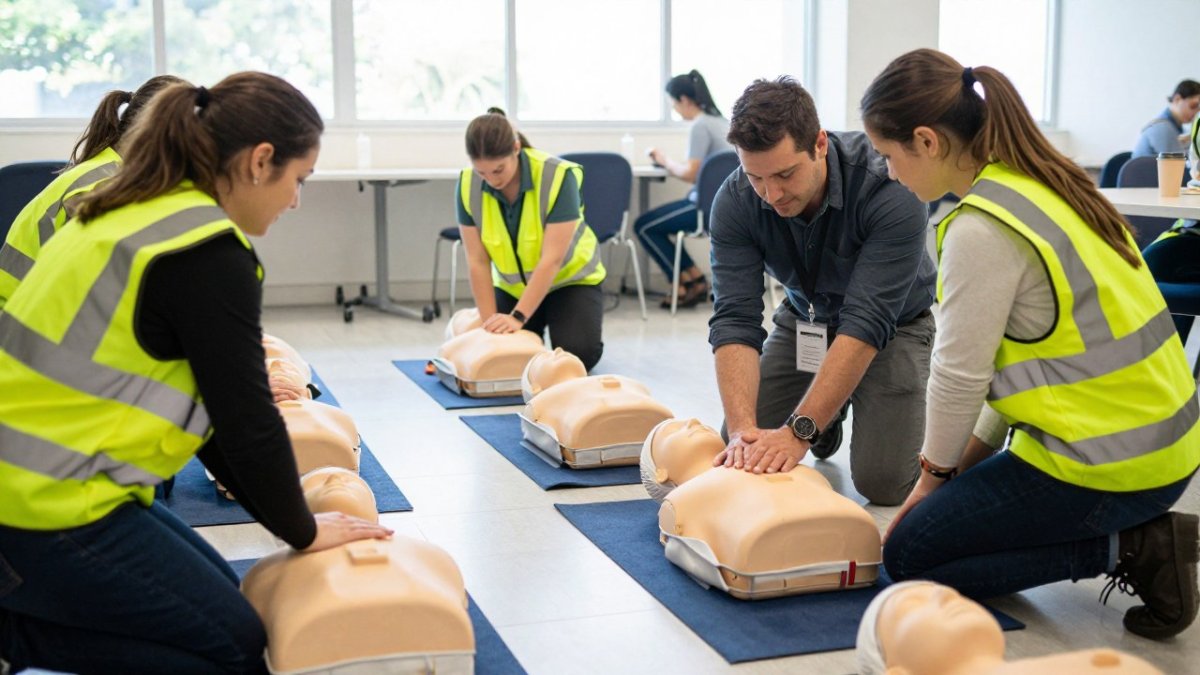
The trade-off is scheduling. A mobile trainer needs a suitable space, your team’s availability, and enough people to justify the visit. Get those three lined up and onsite delivery can work well.
What to check before booking a mobile trainer
- Confirm the provider’s registration and RTO number, and check the units on the scope of registration
- Ask what equipment they bring
- Confirm the space and access requirements for your site
- Ask how certificates and records are issued
Watch out: booking a mobile course without confirming the trainer’s registration covers the specific units you need. A certificate for the wrong unit may not satisfy your compliance obligation.
CPR Training Duration and Refresher Scheduling Across Your Team
CPR training duration is generally short, while a full first aid certificate runs across a longer session. The practical component is the part that matters.
Refresher cycles are where small businesses get caught. CPR skills in particular are often recommended for regular refresh, and full first aid certificates carry their own expiry period. Rather than track this manually, stagger it deliberately.
- Split your team into groups by certificate expiry month
- Book refreshers a month before expiry, not after
- Keep one person designated as the training record keeper
- Review coverage whenever someone resigns or changes shifts
A simple spreadsheet beats memory every time. If you would rather not manage it yourself, ask your provider what record-keeping support they offer.
Matching Course Choice to Business Size, Risk and Industry
The right course depends on what your people actually face, and the fastest way to get it wrong is to copy another business’s training plan.
Question one: what can actually injure someone here? An office with slips, trips and a staff kitchen is a different risk profile from a workshop with power tools, or a childcare centre where anaphylaxis and asthma are live possibilities.
Question two: how quickly can help arrive? A city office with a clinic next door and a fast ambulance response is not the same problem as a remote crew working an isolated site.
Question three: who else is on site? Members of the public, contractors, young workers and volunteers all change the calculation.
Here is how those answers map to common business profiles.
|
Business profile |
Typical need |
Priority units |
|---|---|---|
|
Small office, low hazard |
One or two first aiders, defibrillator on site |
Provide First Aid, CPR refresher |
|
Construction or trades |
Multiple first aiders per crew, remote sites |
Provide First Aid, CPR, industry-specific rescue units |
|
Childcare or education |
Ratio-driven coverage, anaphylaxis and asthma |
Provide First Aid, CPR, asthma and anaphylaxis |
|
Hospitality and retail |
Coverage across shifts, public on site |
Provide First Aid, CPR |
|
Sport and community clubs |
Volunteer coverage at events |
Provide First Aid, CPR |
|
Electrical contracting |
Rescue from live low voltage panels |
Provide First Aid plus the relevant rescue unit |
The HLTAID011 Provide First Aid unit is a common baseline for many workplaces, and it can sit alongside CPR and specialised rescue units. If you are unsure which units apply, describe your work to the provider and let them map it.
A worked example makes the framework concrete.
A reasonable approach is to train slightly above your minimum, since the day someone needs a defibrillator is not the day to discover only one person on shift is trained.
Planning Coverage for Shifts, Leave and Multiple Sites
Coverage planning is easy to overlook, and a single trained first aider on a site with rotating shifts can leave gaps whenever that person takes leave.
Work through it like this:
- List every site, shift and roster pattern
- Identify the minimum number of trained people required on each shift
- Add a buffer of at least one extra trained person per site
- Cross-train across shifts so no single absence breaks coverage
- Revisit the plan quarterly and whenever the roster changes
For multi-site operations, batching the training can simplify scheduling and help keep a consistent standard across sites. Provide First Aid Gold Coast delivers training at your location with all equipment supplied.
Book a Mobile Course at Your Workplace
The compliance question is not whether you have a certificate on file. It is whether the right number of trained people are on site, on every shift, with skills that are current.
Provide First Aid Gold Coast is a training partner of Healthcorp, RTO ID 91222, and brings trainers and all equipment to your workplace. One client said the training was made interesting with real-life scenarios and the major points came across clearly.
Call us to book your course and get your team trained at your own site.
Getting your team trained is a scheduling problem as much as a compliance one, and it is easier to solve than most operators expect. Provide First Aid Gold Coast delivers mobile training at your workplace with all equipment provided, practical scenarios tailored to your industry, and course delivery designed to fit around your roster. Get started with Provide First Aid Gold Coast and have your team certified without losing days to travel.
Frequently Asked Questions
What are the first aid training requirements for small businesses in Australia?
Work health and safety law generally requires a business to provide first aid equipment, facilities and trained staff appropriate to its workplace hazards. The number of first aiders depends on your hazards, workforce size, shift patterns and site remoteness. Review your risk assessment and check the current requirements with your state or territory regulator.
How long does CPR training take, and how often do certificates need renewing?
Course lengths vary, and refresher timing depends on the units involved. Ask the provider for the duration and renewal schedule for each course you need. Many small businesses book a combined refresher in one visit to reduce downtime, especially when staff are spread across shifts or multiple sites.
Is onsite first aid training for employees more cost-effective than sending staff to a college?
Onsite delivery can suit teams of several staff, and it avoids travel and the admin of booking individual seats. For one or two staff, an offsite course may still be simpler. Ask for a group quote based on your headcount and site locations before deciding.
Can a mobile provider train staff across several sites or shifts?
It is worth asking how a provider handles multiple sites or shifts. Confirm the trainer holds current qualifications, that the provider is a registered training organisation, and how certificates are issued. Give your sites, shift times and headcount per location when you request a quote so the schedule is built around your operations rather than the trainer’s convenience.

Recent Comments