
Last Updated: November 15, 2026
Quick Summary
Emergency response training for staff is structured instruction that gives employees the skills, knowledge and confidence to act correctly in the first minutes of a workplace incident, before emergency services arrive. It covers core skills such as recognising an emergency, calling Triple Zero (000), DRSABCD, CPR and AED use, bleeding control and evacuation, and it is a legal WHS duty, not a nice-to-have.
- The first three to five minutes of any emergency decide the outcome, so staff must be trained to act rather than freeze.
- Every employee needs baseline skills including DRSABCD, CPR, AED use, severe bleeding control and evacuation routes.
- Assign named wardens, first aid officers and backups for every emergency role, because an unnamed role is an unfilled role.
- Run a full evacuation drill at least once every twelve months, and more often on high-risk sites.
- Measure training effectiveness through drill performance, not attendance sheets, tracking evacuation times and headcount accuracy.
Table of Contents
- What Emergency Response Training for Staff Covers
- Why Emergency Response Training Is a WHS Duty, Not a Nice-to-Have
- Writing an Emergency Response Plan for Employees
- Workplace Emergency Procedures That Staff Actually Follow
- Emergency Evacuation Training and Drill Frequency
- Workplace First Aid Training and Fire Response Basics
- Building a Step-by-Step Staff Training Program
- Choosing a Provider and Booking Your On-Site Course
- Frequently Asked Questions
What Emergency Response Training for Staff Covers
Emergency response training for staff is the structured instruction that gives employees the skills, knowledge and confidence to act correctly in the first minutes of a workplace incident, before emergency services arrive. This guide from Provide First Aid Gold Coast breaks down what that training must include, how to build a program that holds up under pressure, and how to choose a provider.
The core principle is simple: the first three to five minutes of any emergency decide the outcome. Staff who freeze, panic or guess waste those minutes. Staff who have practised a clear sequence use them well.
Safe Work Australia’s model Code of Practice on first aid in the workplace sets the expectation that employers provide first aid equipment, facilities and trained personnel appropriate to the risks of the site.
Core skills every employee should learn
Every employee, regardless of role, needs a baseline set of practical skills. These are the non-negotiables:
- Recognising an emergency and raising the alarm without delay
- Calling Triple Zero (000) and giving a clear, accurate location and situation report
- DRSABCD action: Danger, Response, Send for help, Airway, Breathing, CPR, Defibrillation
Beyond the physical skills, staff need what trainers call non-technical skills: situational awareness, clear communication and the discipline to follow the plan rather than improvise.
Why Emergency Response Training Is a WHS Duty, Not a Nice-to-Have
Training is a legal obligation, not a staff perk.
The practical consequence is uncomfortable for some employers. If a worker is injured because no one on site knew how to respond, “we never got around to booking training” is not a defence.
There is a commercial argument too. A well-drilled team reduces the severity of injuries, limits downtime after an incident, and protects the business from the reputational damage that follows a serious safety event.
Writing an Emergency Response Plan for Employees
An emergency response plan for employees is the documented set of procedures that tells every worker exactly what to do, where to go and who to report to during an incident.
Start with hazard identification and risk assessment. A construction site, a childcare centre and a warehouse have genuinely different risks, and the plan should reflect that. Map the likely emergency types, then build a procedure for each.
Assigning emergency roles and responsibilities
Clear roles are what separate a plan that works from a document nobody reads. At a minimum, assign:
| Role | Core responsibility |
|---|---|
| Chief warden | Overall coordination and liaison with emergency services |
| Area wardens | Sweeping designated zones and directing evacuation |
| First aid officers | Immediate casualty care until paramedics arrive |
| Communications officer | Calling 000 and relaying updates |
| Assembly point coordinator | Headcount and reporting missing persons |
Name backups for every role. The warden who is off sick on the day of the fire is the rule, not the exception.
Workplace Emergency Procedures That Staff Actually Follow
Procedures fail for one reason: they are written for the auditor, not the person under stress. A procedure staff will actually follow is short, visual and rehearsed.
Write each procedure as a numbered sequence of actions, not paragraphs. Post it where the relevant equipment lives.
Watch out: the most common failure we see is a plan that lists roles but never names the people filling them.
Emergency Evacuation Training and Drill Frequency
Evacuation training should be delivered at induction and refreshed at least annually, with a full evacuation drill run at least once every twelve months and more often on high-risk sites.

A practical drill and refresher schedule
Most practitioners find a tiered schedule works better than a single annual event:
- Induction, every new starter walks the evacuation route, is shown the assembly point and is told who their area warden is before their first shift ends.
- Annual full evacuation, the whole site evacuates to the assembly point, with headcount and a timed result recorded.
- Six-monthly walk-through, a shorter route check and warden briefing that keeps muscle memory alive without disrupting operations.
Record every drill: date, scenario, number of staff involved, evacuation time, headcount accuracy and corrective actions. That record is what a regulator will ask for, and it is what lets you show improvement over time rather than just attendance.
Designing a drill that actually tests the plan
A drill is not a box-tick. It is a test of the plan itself. Time the evacuation, check the headcount process, and note where people hesitated.
A drill worth running has four design choices:
- Announced or unannounced. Announced drills suit new teams and new buildings; unannounced drills reveal what people actually do. Alternate between them across the year.
- Scenario variety. A fire drill tests evacuation; a medical emergency tests first aid response and access for paramedics; a chemical release tests shelter-in-place and isolation. Rotate scenarios so the plan is tested, not just the exit route.
- Realistic constraints. Block a stairwell, close a corridor or place a casualty in a room and see whether wardens adapt. The plan should have an answer for a blocked primary route.
- Debrief immediately. Gather wardens and observers within 24 hours, while memory is fresh, and capture what worked, what failed and who owns each fix.
Watch out: the most common drill failure is treating a fast evacuation time as success. A fast time with an inaccurate headcount means someone may still be inside, headcount accuracy matters more than speed.
Workplace First Aid Training and Fire Response Basics
Workplace first aid training must match the risks on site. Workplaces should have enough trained first aid officers to cover every shift, and high-risk sites need more. Check the current national training package requirements with an accredited provider before booking.
Matching first aid cover to your site
A first aid needs assessment should drive how many officers you train and what equipment you stock. Consider:
- Workforce size and shift patterns, cover every shift, including night shift, weekends and lone-worker periods, not just the day crew.
- Hazard profile, a warehouse with forklifts, a kitchen with burns and scalds, and an office with low physical risk need different kits and different skill mixes.
- Distance from help, remote or regional sites need more trained staff and more comprehensive kits because paramedic response times are longer.
Track expiry dates centrally so no shift is left without a current officer.
Fire response: suppression versus evacuation
Fire response training covers more than extinguisher use. Staff need to understand the fire triangle, which extinguisher suits which fire class, when to attempt suppression and, critically, when to abandon the attempt and evacuate.
Key points every employee should know:
- Fire classes and extinguisher types, water, foam, dry chemical and CO2 extinguishers suit different fires, and using the wrong one on an electrical or cooking-oil fire can make it worse.
- The PASS technique, Pull the pin, Aim at the base, Squeeze the handle, Sweep side to side, practised on a live-fire simulator or training extinguisher, not just described.
- When not to fight, if the fire is larger than a small incipient fire, if smoke is thickening, if the exit could be cut off, or if you are not trained and confident, evacuate and raise the alarm.
Watch out: the most common fire-response error is staff attempting to fight a fire that has already moved beyond the incipient stage, delaying evacuation and putting themselves between the fire and the exit.
Building a Step-by-Step Staff Training Program
Here is the framework we recommend for building a program from scratch:
- Assess the site’s risks and identify which emergency types are plausible.
- Map current skills against the required competencies and note the gaps.
- Plan role-based training so wardens, first aid officers and general staff each get what they need.
- Book accredited training delivered on site, so staff train in their own environment.
- Drill the plan within weeks of training, while skills are fresh.
- Review after every drill and every real incident, and update the plan.
Measuring training effectiveness and post-incident learning
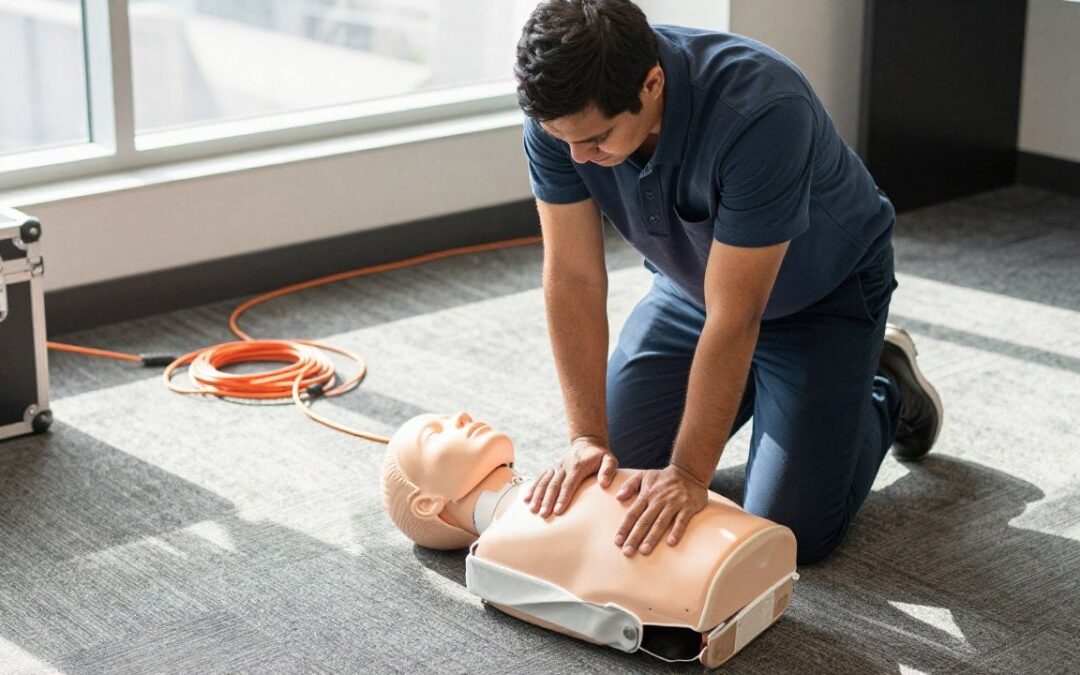
Measure effectiveness through drill performance, not attendance sheets. Track evacuation times, headcount accuracy and how confidently staff perform CPR on a manikin. After any real incident, run a debrief within a week and document what the plan got wrong.
Choosing a Provider and Booking Your On-Site Course
Choose a provider that delivers on site, uses current equipment, and can show you its registration and trainer credentials.
Use this checklist when comparing providers:
- Registered training organisation with a verifiable RTO number
- Accredited, nationally recognised competencies
- On-site delivery
At Provide First Aid Gold Coast, we bring the training to your site with all equipment provided, and we are a training partner of Healthcorp (RTO ID 91222).
Pricing depends on group size, dates and delivery, so contact us for a current quote.
Your team’s readiness is not something to leave until the next audit.
Frequently Asked Questions
What does emergency response training for staff cover?
It covers the practical skills staff need to act during a workplace emergency: recognising hazards, raising the alarm, following evacuation procedures, using fire equipment safely, administering basic first aid and CPR, and understanding their assigned emergency roles. Good programs also include scenario practice, so employees rehearse decisions under pressure rather than just reading a manual. The exact content should match your risk assessment and the emergencies your site could realistically face.
How often should staff receive emergency response training?
Refresh emergency response training regularly, with evacuation drills run at a frequency set by your risk assessment. High-risk sites such as construction and mining often need more frequent practice. Check the current renewal requirements for first aid and CPR with your training provider. Build a calendar that tracks expiry dates for each staff member so no certification lapses quietly, and review the schedule after any incident or major change to your site layout.
What is the difference between emergency response training and first aid training?
First aid training teaches staff to treat injuries and medical emergencies, including CPR, bleeding control and casualty care. Emergency response training is broader: it covers evacuation, fire response, hazard identification, emergency roles and coordination with emergency services, with first aid as one component. Many employers run both, because a workplace first aid training course alone will not prepare a team to manage an evacuation or a fire.
Who should receive emergency response training at work?
Every employee should receive baseline training in evacuation, alarm response and emergency procedures. Beyond that, designate wardens, first aid officers and fire equipment users who receive deeper, role-specific training. High-risk roles such as electricians, confined space workers and rescue teams need accredited competencies on top of the general program. Contractors and visitors should also receive a site induction covering emergency procedures before they start work.
How do you measure whether emergency training actually worked?
Measure it through drills, not just attendance sheets. Time how long evacuation takes, check whether wardens perform their roles, and note where confusion occurs. Run short scenario tests and quiz staff on procedures. After any real incident, review the response and update training accordingly. Tracking these results over time shows whether capability is improving or whether a refresh is needed.
Can training be delivered on-site for teams spread across multiple locations?
Yes. Mobile providers bring trainers and equipment to each site, which suits teams spread across several locations because it removes travel time and lets staff train in their own environment. Coordinate dates site by site and confirm group sizes in advance. On-site delivery also lets trainers tailor scenarios to the hazards of each location, which is harder to achieve when staff travel to a central training college.

Recent Comments