
Quick Summary
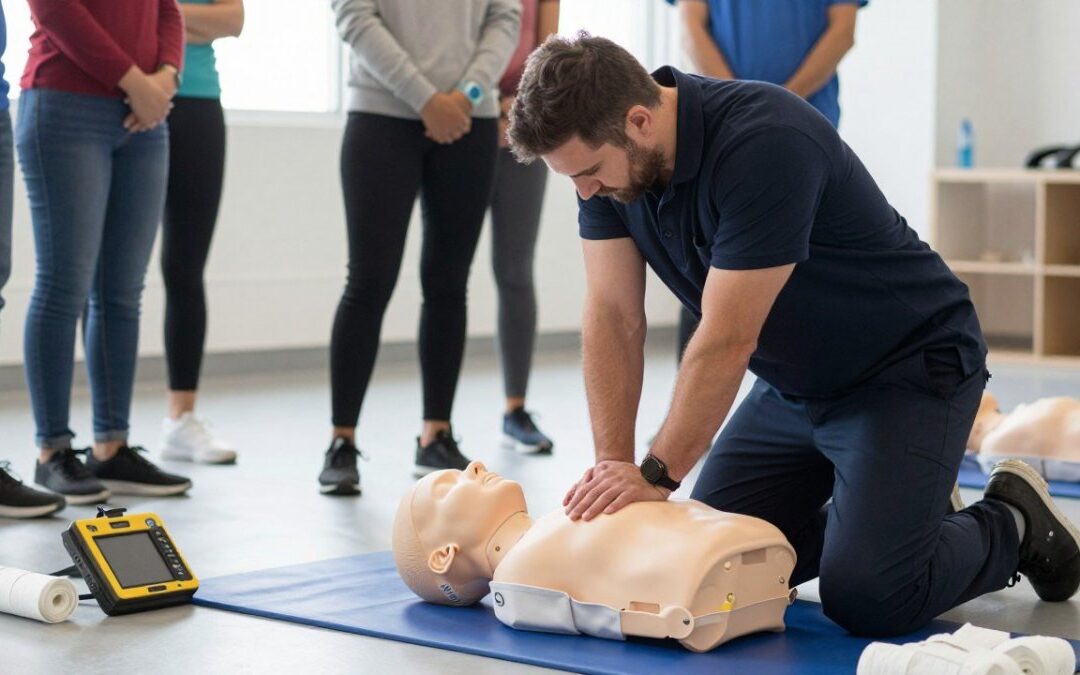
Online first aid training for employees delivers the theory component through a laptop or tablet, so staff can study on their own schedule. The hands-on practical assessment is still required and is arranged separately, usually at the workplace. This blended approach suits busy teams that struggle to release staff from the floor.
- Theory can be completed online at each employee’s own pace.
- Practical skills such as chest compressions and bleeding control need hands-on assessment.
- Nationally recognised qualifications in Australia require demonstrated, assessed practice.
- Schedule practical sessions within two to four weeks of completing the online theory.
- Keep a training register tracking qualifications, expiry dates and renewal reminders.
Table of Contents
- Why Online First Aid Training Suits Busy Teams
- Workplace First Aid Training Requirements in Australia
- Online Versus Blended Training: What Employees Can Learn Remotely
- Choosing the Right Course for Each Role in Your Workplace
- Planning Training Logistics Across a Team or Multiple Sites
- Managing First Aid Certificate Renewal
- Setting Up a First Aid Training Records Template
- Booking Your Team’s Online First Aid Training with Provide First Aid Gold Coast
- Frequently Asked Questions
Why Online First Aid Training Suits Busy Teams
Online first aid training for employees lets staff finish theory on their own schedule, which matters when rosters are tight. Much of the theory can be completed from a laptop or tablet, with the hands-on component arranged separately.
Busy teams usually struggle with three things: time away from the floor, travel to a training venue, and coordinating dates across shifts. Self-paced theory can reduce the time staff spend away from the floor. The second problem is reduced when the practical session comes to the workplace. The third problem gets easier once the theory is done, since only the practical session needs a fixed date.
A common mistake is assuming online training means no practical component. Nationally recognised first aid qualifications in Australia require demonstrated skills, so a credible course will always include assessed practice.
Workplace First Aid Training Requirements in Australia
Workplace first aid requirements vary by state, industry and the size of your workforce. Work health and safety regulators set the baseline, and your own risk assessment determines how many trained people you need on each site and shift. You can check the current obligations on Safe Work Australia first aid guidance.
Start by confirming how many first aid officers your site needs and where they must be located. Then check which qualification the regulator expects for each role. Higher-risk environments generally carry stricter expectations than low-risk office settings. Keep records of who holds which certificate and when it expires.
Workplace first aid training requirements are easy to misread, so document your reasoning. A short written risk assessment shows how you reached your decision about staffing and training levels.
Online Versus Blended Training: What Employees Can Learn Remotely
Online-only learning covers knowledge well. Staff can learn the principles of emergency response, recognise the signs of a medical emergency, and understand the sequence of actions in a first aid situation. They can also revise those concepts whenever they need to.
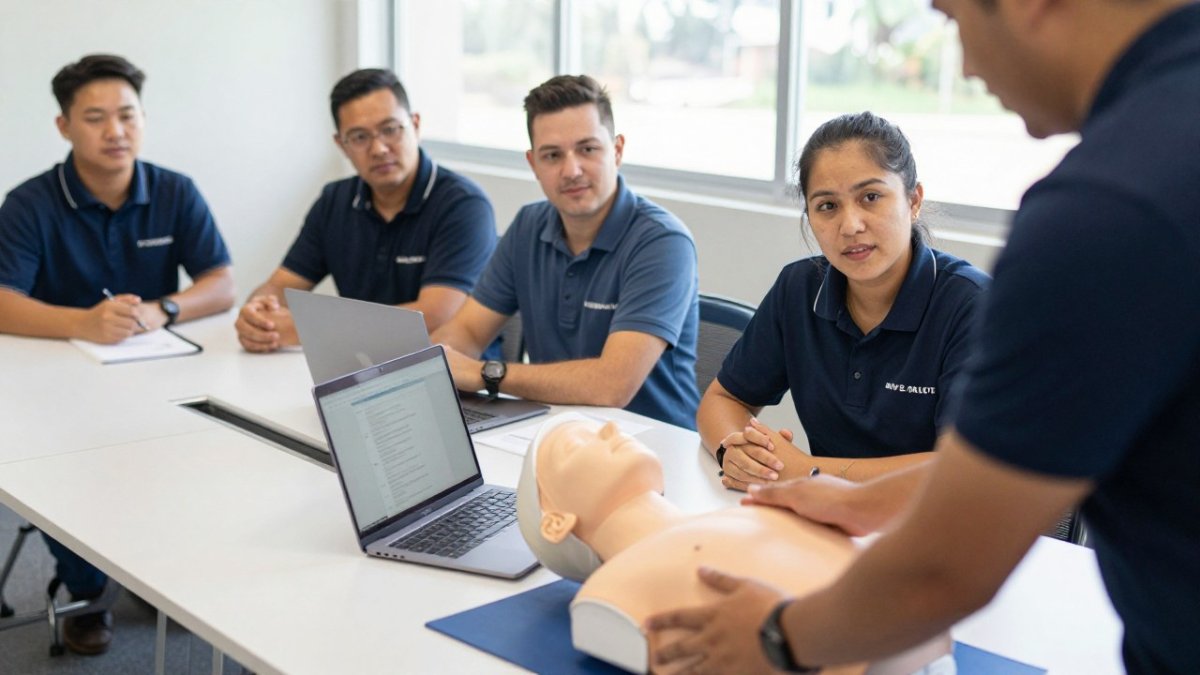
What they cannot learn online is physical skill. Chest compressions, recovery positioning, and controlling bleeding need hands-on practice with a trainer watching for technique. A blended model combines online theory with an in-person practical assessment, which suits many workplaces.
Fully remote delivery suits sites without a dedicated training room, but it still needs a practical component delivered on site or at a venue. If a provider offers a course with no practical assessment, treat that as a warning sign rather than a bargain.
Choosing the Right Course for Each Role in Your Workplace
Deciding which course each role needs, how many trained people must be on site at any one time, and how to justify that decision is often the harder question for an employer. A short, documented method can help answer all three.
Start with a hazard profile for each work area rather than a job title. Walk the site and list what could realistically cause injury: moving machinery, electrical work, work at height, hot surfaces, chemicals, manual handling, lone work, or contact with children or vulnerable people. Note how quickly an ambulance could reach the location and whether staff work alone or in pairs.
Then apply a simple coverage rule. A useful working pattern is for a site to have enough trained first aiders to cover every shift, every break period and every remote or isolated workgroup, with at least one backup per shift to cover leave and absence. High-risk areas usually need a trained responder within a short response distance, while low-risk office floors can rely on a smaller number of trained staff.
Use the following decision prompts for each role group:
- What is the most likely injury or illness here, and does the course cover it?
- How long would an emergency service take to arrive, and does the course prepare staff to sustain care until then?
- Does the role involve children, anaphylaxis risk, or remote work that needs extended content?
- How many people on this shift hold a current certificate, and what happens if one is absent?
- Does the qualification need to be nationally recognised for your compliance records, or is a non-accredited awareness course sufficient?
A role-mapping table helps translate those answers into bookings:
|
Role type |
Typical risk |
Suggested training focus |
|---|---|---|
|
Office and administration |
Low, mostly minor injuries |
General workplace first aid |
|
Trades and construction |
Moderate to high, falls and cuts |
Workplace first aid plus site-specific skills |
|
Childcare and education |
Children’s injuries and allergic reactions |
Paediatric and anaphylaxis content |
|
Field and remote work |
Delayed emergency response |
Extended training and remote-site preparedness |
|
Electrical, heights or confined spaces |
High, sudden cardiac and trauma risk |
CPR, AED and advanced resuscitation content |
Use the table as a starting point, then check each row against your own risk assessment. Where a role sits across two rows, train to the higher risk rather than splitting the difference.
Watch out: choosing a single company-wide course to simplify booking often leaves high-risk roles under-trained and low-risk roles over-trained, and the mismatch is difficult to defend in an incident review.
Record the reasoning in a short written risk assessment: the hazards identified, the coverage rule applied, the qualifications selected and the date reviewed. That document is what turns a training purchase into a defensible compliance decision.
Planning Training Logistics Across a Team or Multiple Sites
Coordinating training for a team spread across several locations takes planning, and logistics are often where workplace programs stall. Begin with a complete training register: every staff member, their role, their site, their shift pattern, their current qualification and its expiry date. This register becomes the single source of truth for scheduling, coverage checks and renewal reminders.
Group people by site and shift pattern, then book practical sessions to suit each group. Where possible, deliver training at the workplace so staff do not lose travel time and equipment is set up in a familiar space. Plan for absences by booking a slightly larger group than you need and keeping a waiting list for replacements.
Set a deadline for completing the online theory component, then schedule the practical sessions within two to four weeks of that date. Leaving a long gap between theory and practice reduces retention, and staff who complete theory months before their practical often arrive unprepared. Communicate the schedule early, confirm attendance in writing, and send a reminder a few days before each session.
Before booking, confirm the technical and accessibility requirements for the online component:
- Device and browser: check whether the course runs on phones and tablets or needs a desktop, and whether it requires a specific browser or app.
- Internet: confirm the minimum connection speed and whether the platform supports low-bandwidth or offline viewing.
- Audio and video: check whether headphones are needed and whether captions or transcripts are available.
- Accessibility: ask about screen-reader compatibility, adjustable text size and extra time for assessments where a staff member needs it.
- Language and literacy: confirm whether plain-English support or interpreter arrangements are available for staff who need them.
Tracking completion is the step that turns a booking into a managed program. Ask the provider whether they supply a completion report you can import into your register, and whether managers can view progress by site or team.
Budgets matter too. Pricing depends on group size, number of sites, delivery dates and whether training happens on your premises. Request a written quote that itemises each component, so you can compare providers on a like-for-like basis. For current prices or a quote, contact Provide First Aid Gold Coast directly.
Watch out: booking practical sessions before confirming that staff can access the online platform on their work devices often causes last-minute cancellations and wasted session places.
Review the logistics plan after each round of training. Note which sessions ran to schedule, which staff needed extra support, and where the register fell out of date.
Managing First Aid Certificate Renewal
Most first aid certificates expire after a fixed period, and the exact term depends on the qualification. Renewal is the step most workplaces forget. A certificate that lapses without warning can leave a site without a qualified responder and create a compliance gap.
Set a reminder for every certificate well before expiry. Schedule refresher training early enough that staff are not rushed into a course at the last minute. Tracking renewals in a shared spreadsheet or a training log works well for small teams, while larger organisations often use dedicated compliance software.
Check the renewal requirements for each qualification with the training provider or the relevant regulator. Some qualifications require a full course, while others allow a shorter refresher. Confirm which one applies before booking.
Setting Up a First Aid Training Records Template
A training records template keeps your compliance information in one place and makes audits faster. At minimum, record each employee’s name, role, site, qualification, date completed, expiry date, and the provider that delivered the training. Add a column for renewal reminders so nothing falls through the gaps.
Store the template somewhere accessible to managers but protected from accidental changes. Update it every time someone completes or renews training. Keep copies of certificates alongside the register so you can produce evidence quickly if a regulator asks.
Review the register at least quarterly. Check that every role on site has a currently qualified person covering each shift. Gaps found in a review are far easier to fix than gaps found during an incident.
Booking Your Team’s Online First Aid Training with Provide First Aid Gold Coast
Provide First Aid Gold Coast delivers mobile first aid training, bringing all training equipment and experienced trainers to your workplace. The service suits teams that cannot easily leave their site. The business is a training partner of Healthcorp, and holds RTO ID Number 91222.
Past participants have described the practical sessions in positive terms. One client wrote that the trainer “made sure everyone on my team was up to speed and ready for the real world with their First-Aid certifications.” Another said the course “was made interesting with real life scenarios.”
To plan training for your team, call Provide First Aid Gold Coast to book your course. Have your staff list and site details ready, and the team can confirm dates, numbers and the right course for each role.
Frequently Asked Questions
Can employees complete first aid training entirely online?
Some of the course can be completed online, but nationally recognised first aid qualifications in Australia include a practical assessment in which the learner performs CPR and other skills in person. Online-only options usually cover theory and knowledge components. Blended training combines the online theory with a face-to-face practical session, which is why many employers choose it. Check with your provider which parts are delivered remotely and how the practical assessment is arranged before enrolling staff.
How often should workplace first aid certificates be renewed?
The currency period for nationally recognised first aid and CPR certificates depends on the qualification held. Renewal is best scheduled before expiry so there is no gap in coverage. Keeping a register of issue and expiry dates makes it easier to book refreshers in time, particularly across a larger team. Confirm the currency period on your individual certificate, as it depends on the qualification held.
How many first aiders does a workplace need?
The number of trained first aid officers depends on the size and risk level of your workplace, and is generally guided by the Work Health and Safety Regulations and your state or territory WHS regulator. Higher-risk sites such as construction and mining typically need more trained staff than low-risk offices. Review your risk assessment and your jurisdiction’s guidance to determine the right number of first aiders and their locations on site.
How can employers track staff first aid certificates?
A simple training records template works well for most teams. Record each employee’s name, role, course completed, certificate number, issue date, expiry date and the trainer or provider. Review the register regularly and set reminders well ahead of each expiry so refresher bookings are not missed. Keep copies of certificates on file so you can verify qualifications during audits or inspections.

Recent Comments