Last Updated: November 12, 2026
Quick Summary
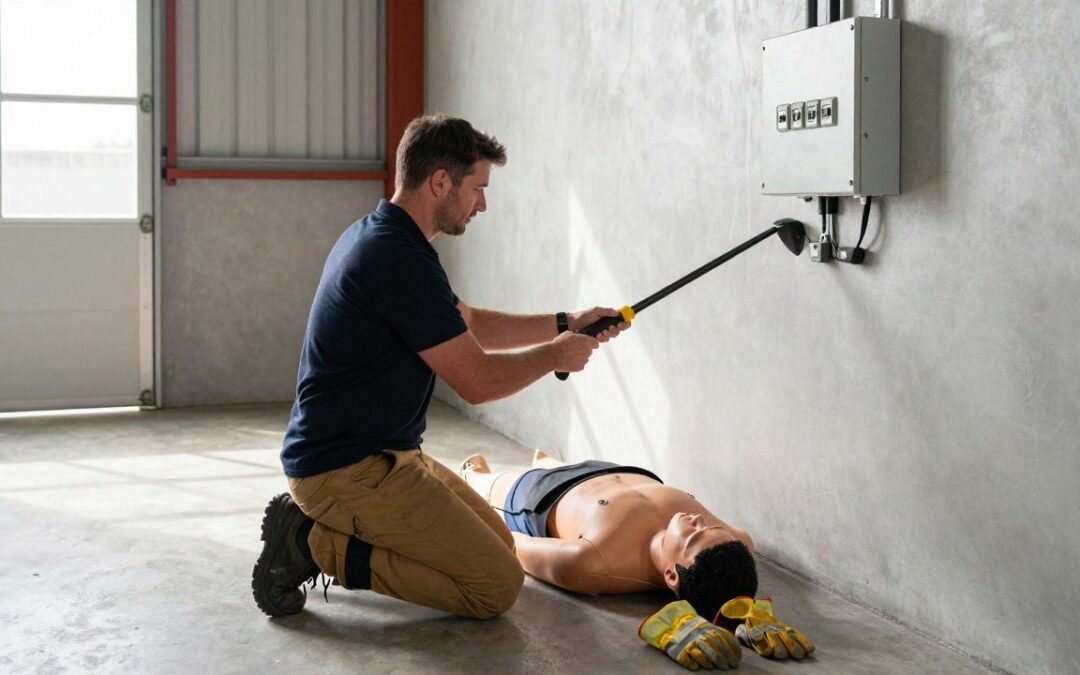
Choose lv panel rescue training by confirming the exact unit code your employer, site or regulator requires, then pick a provider that delivers face-to-face training on a simulated panel with rescue hooks and mats supplied. Check that assessment is scenario-based and individual, and that group sizes are capped so everyone gets real practice time.
- Confirm the required unit code UETDRMP018, in writing before you pay.
- The course assessment has a knowledge component and a practical, scenario-based component.
- CPR sits inside this training because electric shock can stop the heart.
- Keep insulated rescue hooks and mats at the panel, not in a distant cupboard.
- Provide First Aid Gold Coast holds RTO ID Number 91222 and trains on your site.
- UETDRMP007 is a nationally recognised Australian unit of competency titled Perform rescue from a live low voltage (LV) panel.
Note: UETDRMP007 has been superseded by UETDRMP018
Table of Contents
- What LV Panel Rescue Training Covers and Who It’s For
- UETDRMP007 (superseded) vs UETDRMP018: Which Unit Do You Need?
- UETDRMP018 Perform Rescue From a Live Low Voltage Panel: What to Expect
- How the LV Panel Rescue Course Assessment Works
- CPR, First Aid and Casualty Care After an Electrical Incident
- Refresher Frequency, Certificate Validity and Workplace Implementation
- Course Selection Checklist: Cost, Delivery and Support
- Book Your On-Site LV Panel Rescue Course
- Frequently Asked Questions
What LV Panel Rescue Training Covers and Who It’s For
LV panel rescue training for electricians is the nationally accredited instruction that prepares electrical workers to rescue a colleague from a live low-voltage panel without becoming a casualty themselves. At Provide First Aid Gold Coast, we deliver this as hands-on, on-site training because the skills only stick when people practise them on real equipment.
The course exists because live work happens. Fault-finding, testing and commissioning on energised equipment are routine tasks, and the moment something goes wrong, the person standing nearest the panel is the one who has to act. Waiting for an ambulance is not a rescue plan.
Who it is for: licensed electricians, electrical contractors, apprentices working under supervision, and any electrical worker who performs live low-voltage work or works near live electrical equipment. Many employers also put safety officers and site supervisors through the course so someone on every shift knows the sequence cold.
The core of the program is the rescue itself, not the theory.
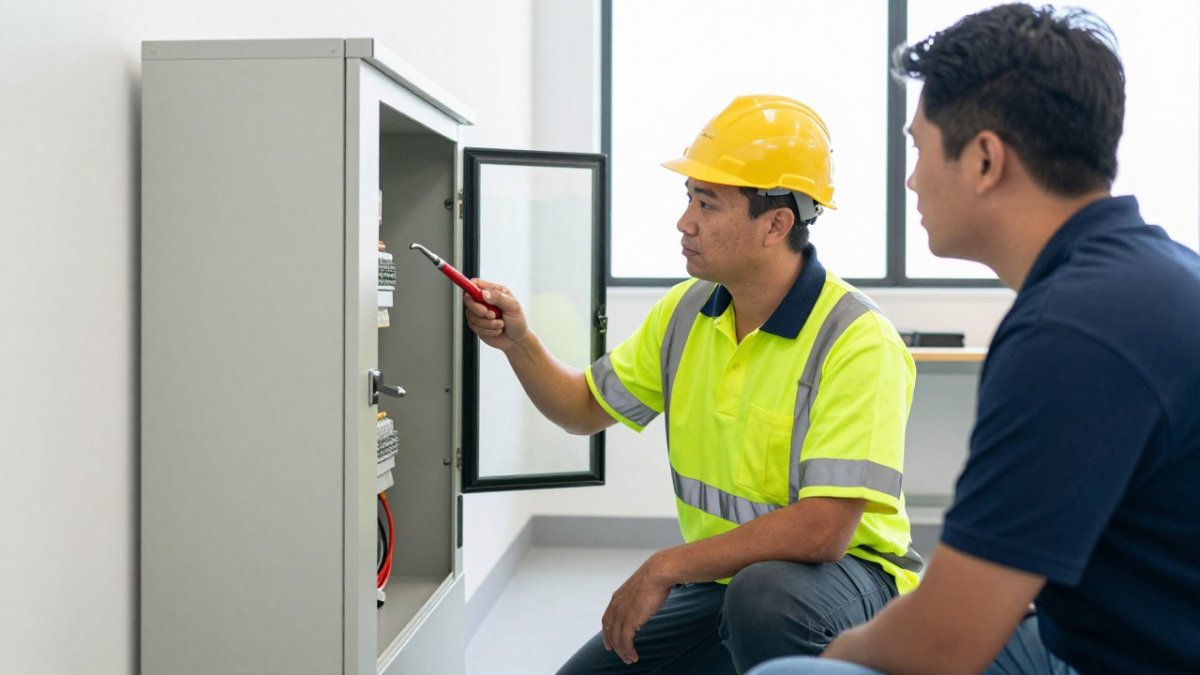
The skills you’ll practise on a simulated panel
- Assessing the scene before you touch anything
- Attempting isolation and confirming the panel is de-energised
- Selecting and using insulated rescue hooks and insulating mats
- Removing a casualty safely and checking for response
- Calling for help and handing over to emergency services
A common mistake is treating the hook as the whole skill. It isn’t. The judgement about whether to touch the panel at all comes first, and trainers watch for it closely.
UETDRMP007 (superseded) vs UETDRMP018: Which Unit Do You Need?
The two unit codes trip up a lot of people, and getting the wrong one wastes both time and money. The authoritative source for what each unit covers is the current version on the national register.
Which one you need is a compliance question, not a preference question. Work through it in this order:
- Check your employer’s safety documentation. Look for the exact unit code named in procedures, SWMS, or training matrices. If a code is specified, that is the code you need.
- Check the site or client requirement. Principal contractors and asset owners sometimes mandate a specific unit by name in their induction or contractor requirements.
- Check the regulator or scheme rules that apply to your work. Some licensing and registration arrangements reference particular units. Confirm against the current requirements rather than assuming.
- Check the national register. Search both codes on the national training register to confirm current title, status and any superseded or equivalent information before you enrol.
Watch out: a certificate that names the wrong unit can be rejected at site induction even though the rescue skills are identical. Get the unit code confirmed in writing before you pay.
UETDRMP018 Perform Rescue From a Live Low Voltage Panel: What to Expect
UETDRMP018 Perform Rescue From a Live Low Voltage Panel is a short, practical unit built around one outcome: you can safely rescue a person in contact with live low-voltage equipment and keep them alive until help arrives. There is no padding in it.
What most guides miss is how physical the unit is. You will be kneeling, reaching and moving a casualty’s body weight. Electricians with knee or back issues should mention it when booking so the trainer can adapt the drill.
How the LV Panel Rescue Course Assessment Works
The LV panel rescue course assessment has two parts: a knowledge component and a practical, scenario-based component. You must be marked competent in both. The written questions confirm you understand the hazards and the rescue sequence; the practical confirms you can execute it under pressure.
Assessment is individual. Watching someone else do it well does not count, and trainers are required to see you complete the full sequence yourself.
Scenario-based assessment and competency sign-off
Sign-off happens on the day when you meet the standard. Your certificate is then issued against the unit of competency, and your employer can file it against the relevant training record.
CPR, First Aid and Casualty Care After an Electrical Incident
Removing someone from a panel is only half the job. Electric shock can stop the heart, and the casualty may need cardiopulmonary resuscitation before an ambulance arrives. That is why CPR sits inside this training rather than beside it.
After the casualty is clear of the electrical hazard, the sequence moves to casualty care: checking for response and normal breathing, calling emergency services, and starting CPR if they are unresponsive and not breathing normally. If you are not currently certified in CPR, do the full first aid course alongside the rescue unit. The Australian Resuscitation Council guidelines set out the current compression and breathing ratios that trainers teach against.
Refresher Frequency, Certificate Validity and Workplace Implementation
Currency is determined by a combination of the unit’s own requirements, your employer’s electrical safety management system, and any site or client rules that apply to your work.
Check it in this order:
- The unit’s current requirements. Confirm on the national training register whether the unit specifies a currency or refresher expectation, and whether the version you hold has been superseded.
- Your employer’s procedures. Many electrical contractors set their own refresher interval in their safety management system. That interval, not a generic number, is what your workplace will enforce.
- Site and client requirements. Principal contractors and asset owners may set shorter intervals for work on their sites. Check the induction and contractor requirements.
- Your own risk profile. If you work live regularly, or your team has had near misses, a shorter cycle is a judgement call worth making even where the minimum is longer.
- Equipment in reach. Insulated rescue hooks and mats stored in a locked cupboard two buildings away are useless. Keep them at the panel, and check them as part of your routine equipment inspection.
- A site-specific rescue plan. The training sequence is generic by necessity. Your site emergency plan should name the panel locations, the isolation points, the rescue equipment, and who calls emergency services.
- Named rescuers per shift. Everyone trained is good; someone trained on every shift is better. Build a simple register of who holds which unit and when it falls due.
- A drill schedule. Run a simulated rescue periodically so the sequence stays familiar and new starters see it done properly.
Watch out: treating a rescue certificate as a substitute for a site-specific plan is the most common implementation failure. The certificate proves the individual can act; the plan tells them where to act and with what.
If you manage a team, diarise refreshers against the register rather than chasing them manually. Certificates lapse unnoticed when renewal depends on someone remembering.
Course Selection Checklist: Cost, Delivery and Support
Choosing a provider comes down to delivery model, group size and how the practical work is run. Pricing depends on group size, location and dates, so ask for a quote rather than comparing headline rates that may not include travel or equipment.
Use this checklist before you book:
- The provider names the exact unit code you need, in writing
- Training is face-to-face with a simulated panel, not online-only
- Insulating equipment and rescue hooks are supplied on the day
- Group size is capped so everyone gets real practice time
- The trainer holds current industry experience, not just a certificate
- Certificates are issued promptly after competency sign-off
- The provider can come to your site, so your team trains on familiar ground
- CPR and first aid can be bundled into the same visit
That last point matters more than most buyers expect. Coordinating two providers across three sites is a scheduling problem nobody needs.
We are a training partner of Healthcorp and hold RTO ID Number 91222, so you can verify our registration before booking. Our trainers come to your workplace with all equipment.
|
Decision point |
What to check |
Why it matters |
|---|---|---|
|
Unit code |
UETDRMP018 named in writing |
Wrong unit fails site induction |
|
Delivery |
Face-to-face with simulated panel |
Online-only cannot build real competency |
|
Equipment |
Hooks, mats and insulating gear supplied |
You cannot practise without them |
|
Group size |
Capped numbers per trainer |
Practice time per person |
|
Assessment |
Scenario-based, individual sign-off |
Confirms you can act alone |
|
Currency |
Refresher interval confirmed |
Prevents lapsed certification |
Book Your On-Site LV Panel Rescue Course
Provide First Aid Gold Coast brings the training to your site with all equipment supplied, delivered by trainers with extensive first aid and CPR experience.
Call us to book your course and lock in a date that fits your crew’s roster.
Electricians face live panels more often than most trades face any hazard at all. Give your team the rescue sequence, the CPR skills and the confidence to act. Get started with Provide First Aid Gold Coast and book on-site LV panel rescue training that fits around your jobs.
Frequently Asked Questions
Does LV panel rescue training include CPR?
Yes. Live low-voltage panel rescue training must include cardiopulmonary resuscitation and casualty care. After isolating and removing a casualty from a live panel, the next priority is checking responsiveness, calling triple zero and starting CPR if the person is unresponsive and not breathing normally. Most nationally accredited courses combine the rescue unit with a CPR refresher so you leave with both competencies signed off.
How often should electricians refresh their LV rescue skills?
Refresher timing depends on your employer’s risk management system and site requirements. Check your workplace safety policy and keep your certificate current, because an expired competency can stop you from working on or near live electrical equipment.
How is live low voltage panel rescue training assessed?
Assessment is practical and scenario-based. You will demonstrate the full rescue sequence on a simulated panel: risk assessment, isolation, donning insulating gloves, using a rescue hook, removing the casualty and providing further care including CPR. A trainer observes each step against the unit of competency criteria and signs off your competency assessment.
What should electricians check before booking an LV panel rescue course?
Confirm the provider delivers the correct unit of competency, such as UETDRMP007 or UETDRMP018, and that it is nationally accredited. Ask about face-to-face delivery, class size, access to a simulated panel, and whether CPR is included. Check the trainer’s experience, the RTO number, and whether on-site training is available for your team. Get a written quote covering all equipment and assessment fees.
UETDRMP007 is a nationally recognised Australian unit of competency titled Perform rescue from a live low voltage (LV) panel.
Note: UETDRMP007 has been superseded by UETDRMP018

Recent Comments