
Table of Contents
- Why Businesses Look for a First Aid Pro Alternative
- Choosing a Workplace First Aid Provider: What to Compare
- Onsite First Aid Training for Businesses: How It Works
- Accredited First Aid Courses for Employees
- CPR Refresher Course Duration and Renewal Tracking
- Group Pricing, Logistics and Multi-Site Coordination
- Conclusion
- Frequently Asked Questions
Last Updated: October 14, 2026
Why Businesses Look for a First Aid Pro Alternative
Searching for a first aid pro alternative for businesses usually starts with the same complaint: the training is treated as a box to tick. Staff sit through slides, pass a quiz, and walk out no more confident than when they arrived.
This guide from Provide First Aid Gold Coast sets out what actually matters when you compare providers.
The core problem is not a shortage of providers. It is that most quotes look identical on paper. The differences sit in delivery format, assessment quality, and whether the provider can coordinate training across multiple sites without disrupting operations.
Choosing a Workplace First Aid Provider: What to Compare
Compare providers on five things: accreditation, delivery format, assessment style, scheduling flexibility, and how they handle certificates and renewals. Everything else is marketing.
Accredited training means the course is delivered by a registered training organisation and leads to a nationally recognised qualification. Non-accredited courses can still teach useful skills, but they will not satisfy a workplace qualification requirement.
Ask each provider:
- Which units of competency are issued, and under which RTO?
- Is assessment face-to-face, or completed online before a short practical session?
- Who are the trainers, and what is their current industry experience?
- How are certificates issued, and how quickly?
- Can training run at our site, and what facilities do you need?
A common mistake is booking on price alone, then discovering the practical component was a five-minute demonstration. Employers often only find out when an incident occurs.
A Business-Focused Comparison Framework
Most comparison pages list providers by course type. That is not how a business buys training. A more useful approach is to score each provider against the criteria that actually affect your operation, then weight them for your context.
|
Criterion |
What to check |
Why it matters to a business |
|---|---|---|
|
Accreditation |
RTO number, unit codes issued, scope of registration |
Determines whether the certificate satisfies your WHS obligations and any industry regulator |
|
Delivery format |
Onsite, offsite, blended, online-only |
Affects staff travel time, lost productivity and whether the practical assessment is credible |
|
Assessment quality |
Trainer-to-participant ratio, time on manikins, scenario realism |
The difference between a tick-and-flick certificate and a team that can actually respond |
|
Scheduling flexibility |
Weekends, after-hours, split shifts, back-to-back sessions |
Lets you train around rosters instead of closing the site |
|
Certificate turnaround |
Same-day, 24 hours, or posted |
Matters when you need evidence for an audit or a new starter |
|
Renewal administration |
Reminders, group booking, record keeping |
Reduces the risk of a silent compliance gap |
|
Multi-site capability |
Travel between locations, shared equipment, one invoice |
Determines whether a single provider can cover a dispersed workforce |
|
Insurance and indemnity |
Public liability, professional indemnity |
Protects you if something goes wrong during training |
Score each provider out of five on every row, then weight the rows that matter most to your operation. A construction firm with a dispersed workforce should weight multi-site capability and scheduling flexibility heavily. An office-based business with a single location can weight certificate turnaround and renewal administration instead.
Verification Before You Book
Before committing, verify the provider rather than trusting the website:
- Check the RTO number on the national register of training organisations.
- Confirm the exact unit codes the provider is scoped to deliver.
- Ask for a sample certificate so you can see what will be issued.
- Request the trainer’s current industry experience, not just their qualification.
- Confirm what happens if a participant does not meet the assessment standard.
A provider that hesitates on any of these questions is a risk you do not need to take.
Australian Skills Quality Authority guidance on nationally recognised training
Onsite First Aid Training for Businesses: How It Works
Onsite first aid training for businesses brings the trainer, manikins, bandages and assessment materials to your workplace, so your team trains in the environment where they would actually respond.
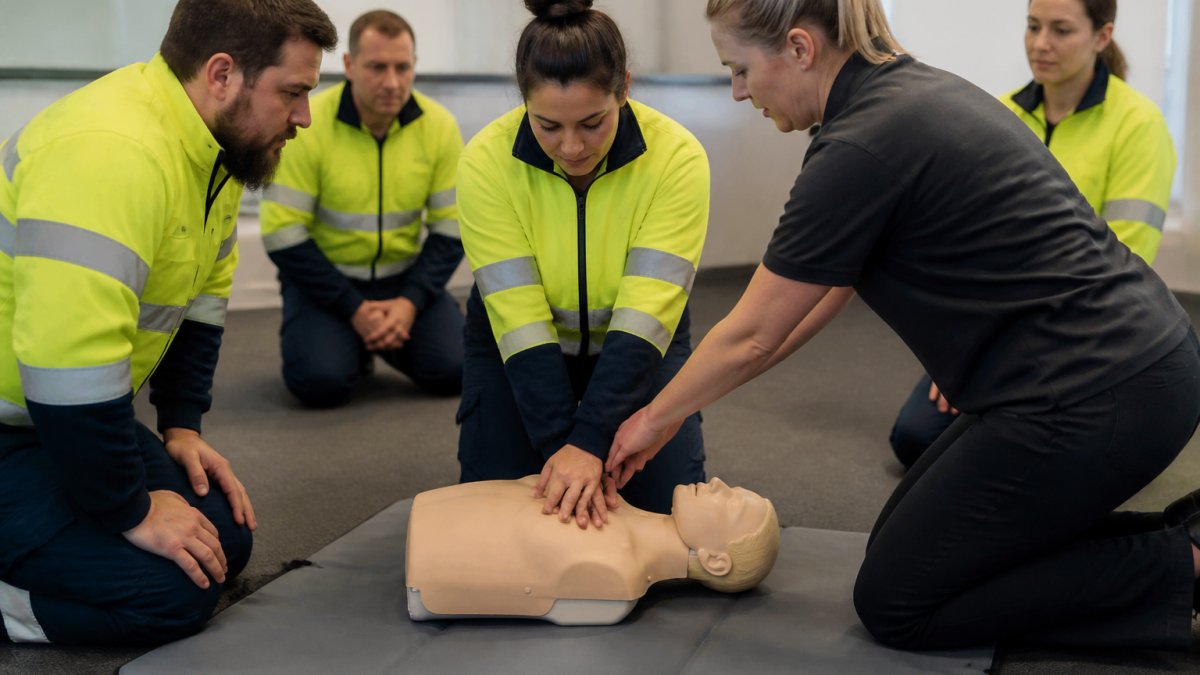
The process is straightforward:
- Scope the group. Tell the provider how many staff need training, which sites they work across, and whether any roles need specialist units.
- Confirm the format. Most providers offer a blended option where theory is completed online and the practical assessment happens in person.
- Check the space. You need a room with floor space for CPR practice, plus power and seating. A site crib room usually works.
- Book a date. Onsite delivery means no travel time for staff and no closed office while half the team is off-site.
- Complete assessment. Participants demonstrate CPR, bleeding control, and casualty management on manikins under trainer supervision.
The practical benefit is not just convenience. Staff who train together in their own workplace tend to remember where the kit is, who the wardens are, and how the response should run.
Book onsite sessions in the quietest part of your operational week. Teams that train during a lull retain more than teams pulled off a busy shift.
Accredited First Aid Courses for Employees
Accredited first aid courses for employees lead to nationally recognised units, which is what most workplaces actually need.
Provide First Aid is the standard workplace qualification. It covers CPR, bleeding control, burns, fractures, asthma, anaphylaxis and casualty management, and it typically runs as a one-day course or a blended equivalent.
Provide CPR is the shorter unit focused on resuscitation only.
Childcare first aid is a separate consideration for early learning centres.
|
Course |
Typical duration |
Best for |
|---|---|---|
|
Provide First Aid |
One day, or blended |
General workplace teams |
|
Provide CPR |
A few hours |
Refresher and nominated CPR staff |
|
Childcare first aid |
One day |
Early learning and education staff |
For teams that need a qualification rather than a skills update, confirm the exact unit code before booking. It should appear on the certificate.
CPR Refresher Course Duration and Renewal Tracking
CPR refresher course duration is short, often a few hours, but the administration around it is where most businesses come unstuck. Certificates expire, staff change roles, and nobody notices until an audit.
The practical answer is to treat renewal as a calendar problem, not a training problem. Build a simple register that records each employee’s name, the unit completed, the completion date, and the expiry date.
What most guides miss is how much money sits in scattered bookings. Ten staff renewing individually across ten different dates costs far more in lost time than one coordinated session.
Group Pricing, Logistics and Multi-Site Coordination
Group pricing for onsite training depends on participant numbers, travel distance, session length and how many sites are involved. Providers generally quote per group rather than per head, which means the cost per person falls as the group grows. That is the single most important pricing fact for a business buyer, and it is the one most comparison pages omit.
What Actually Drives the Quote
When you request a group quote, ask the provider to break it down against these drivers:
- Participant numbers. A group of eight to twelve is usually the sweet spot. Below that, the fixed cost of the trainer and equipment is spread across too few people. Above that, you may need a second trainer to keep the practical assessment credible.
- Travel distance and time. Onsite delivery carries a travel component. A provider based close to your site will usually be cheaper than one travelling across the city, even if the headline rate looks similar.
- Session length and format. A full-day Provide First Aid course costs more in trainer hours than a short CPR refresher. Blended delivery can reduce face-to-face time but shifts some of the burden onto staff completing theory online.
- Number of sites. Each additional location adds travel and setup time. Providers that can run back-to-back sessions in one day, or train multiple sites in the same week, can share those costs across the group.
- Equipment and consumables. Manikins, hygiene supplies, bandages and assessment materials are usually included, but confirm this in writing.
- After-hours or weekend delivery. Some providers charge a loading for sessions outside standard business hours. If your operation runs 24/7, ask about this upfront.
Multi-Site Coordination: A Practical Sequence
For multi-site operations, the sensible sequence is to train the largest site first, then schedule the remaining locations in the same week so equipment and trainer travel are shared. A few mechanics make this work:
- Centralise the booking. One point of contact, one invoice, one schedule. Scattered bookings across sites are how renewals get missed.
- Cluster by geography. Group sites that are close together into the same day or the same week to reduce travel loadings.
- Stagger by shift. Train the day crew and the night crew separately rather than pulling everyone off the floor at once.
- Standardise the units. If every site completes the same unit codes, your records and renewals stay consistent.
- Nominate a site contact. Each location needs someone responsible for the room, the roster and the attendance list.
The Hidden Cost of Scattered Bookings
What most guides miss is how much money sits in scattered bookings. Ten staff renewing individually across ten different dates costs far more in lost time than one coordinated session.
A simple way to test this is to add up the staff hours lost to training across a year, then compare a coordinated group model against a scattergun one.
Our approach at Provide First Aid Gold Coast is to bring everything required to your location, including manikins, training equipment and experienced trainers, so your team trains without leaving site.
Ask for a written quote that separates the group rate from travel and any after-hours loading. It makes comparing providers on total cost far easier than comparing headline rates.
Conclusion
Coordinating first aid certification across a workforce is genuinely difficult. Certificates expire at different times, sites run on different schedules, and a lapsed qualification is a risk you carry silently until something goes wrong.
Provide First Aid Gold Coast takes that coordination off your plate. We come to your location, bring all training equipment, and deliver practical, easy-to-understand courses that prepare your team for real emergencies. Our trainers have extensive first aid and CPR experience, and we work around your operational schedule.
Call us to book your course and get your team certified without closing the site.
Frequently Asked Questions
What are the best alternatives to First Aid Pro for businesses?
Businesses looking for a First Aid Pro alternative often compare mobile onsite providers, local training colleges and national chains. Mobile providers bring trainers and equipment to your site, which cuts travel time and lets you train whole teams at once. When comparing, check whether courses are nationally recognised, whether the provider is an RTO, and whether they can schedule multiple sessions across different locations. Pricing depends on group size, dates and delivery, so request a quote for your specific needs.
How should a business choose a workplace first aid training provider?
Start with compliance: confirm the provider delivers nationally recognised courses and holds current RTO registration. Then look at delivery options (onsite, public classes or blended), trainer experience, group pricing and scheduling flexibility. Ask for references or read provider reviews from other businesses in your industry. For teams spread across multiple sites, check whether the provider can coordinate sessions at each location without disrupting operations. A quick phone call to discuss your training needs will usually reveal how organised and responsive they are.
Can first aid training be delivered at a business’s workplace?
Yes. Many providers, including mobile trainers, deliver first aid training at your workplace. They bring all equipment, including manikins, AED trainers and first aid kits, and run the course in a suitable room or undercover area. Onsite training works well for teams of 10 or more and can be scheduled around shifts. It removes travel time for staff and lets training reflect your actual work environment. Check that the provider has public liability insurance and can accommodate your site’s access and safety requirements.
Do employers accept online first aid certificates in Australia?
It depends on the course and the employer’s requirements. Nationally recognised first aid certificates usually require a practical assessment component, so fully online courses without any hands-on assessment may not be accepted for workplace compliance. Blended learning, where theory is completed online and practical skills are assessed in person, is widely accepted. Always check with your employer or industry regulator about what evidence they require. When booking, confirm the certificate includes the practical assessment and that the provider is a registered training organisation.
Recent Comments