
Table of Contents
- Workplace First Aid Compliance Requirements 2026: What Changed
- First Aid Risk Assessment in the Workplace: The 4-Step Method
- How Many First Aiders Does Your Workplace Need in 2026?
- Workplace First Aid Kit Requirements and Facilities
- First Aid Certificate Renewal in the Workplace: Keeping Staff Current
- First Aid Training Records Template and Audit Evidence
- State and Territory Differences in First Aid Compliance
- Frequently Asked Questions
Last Updated: October 12, 2026
Workplace First Aid Compliance Requirements 2026: What Changed
Workplace first aid compliance requirements in 2026 rest on one principle that has not moved: under the model Work Health and Safety Act, a person conducting a business or undertaking (PCBU) must provide first aid so that workers receive immediate treatment for injuries and illness. What has shifted is how regulators expect you to prove it.
This guide breaks down the current obligations, the coverage maths most businesses get wrong, and the evidence you need on file before an inspector asks. Below, we cover the 2026 change log, state and territory differences in one place, and practical first-aider calculations you can apply this week.
The 2026 change log: what actually shifted
No sweeping rewrite of first aid law landed this year. The changes are practical and jurisdictional: several regulators have refreshed their guidance material, sharpened inspection expectations around documented risk assessments, and pushed harder on evidence of currency for trained first aiders.
The throughline is enforcement, not legislation. Regulators increasingly ask for three things: your risk assessment, your training records, and your kit inspection log. If those three documents are current and coherent, most audits go smoothly. If they are missing or contradictory, the conversation gets expensive.
Why the model WHS Act and Code of Practice still set the baseline
The model Work Health and Safety Act and the accompanying model Code of Practice on First Aid in the Workplace remain the foundation. The Code is not law in itself, but courts and regulators treat it as the benchmark for what a reasonable PCBU would do.
Every state and territory has adopted the model framework in some form, with local variations. That is why a single national policy document will not satisfy every jurisdiction if you operate across borders. Build your program on the model, then layer state specifics on top.
First Aid Risk Assessment in the Workplace: The 4-Step Method
A first aid risk assessment is the documented process of identifying hazards, assessing the likelihood and severity of injury, and determining what first aid resources your workplace needs. It is the first thing a regulator asks for, and the document most businesses do badly.
We group the work into four steps:
- Identify hazards by work area, task, and shift pattern. Include plant, chemicals, electrical work, heights, and lone work.
- Assess risk level for each area: low, moderate, or high. Distance from medical help is a factor, not just the hazard itself.
- Determine required resources: number of trained first aiders, kit type and quantity, facilities, and communication methods.
- Document and review at least annually, or whenever work processes, site layout, or workforce numbers change.
How Many First Aiders Does Your Workplace Need in 2026?
There is no single national number, and any guide that gives you one is oversimplifying. Coverage depends on workforce size, risk level, and how far your site sits from medical assistance.
The model Code of Practice sets out indicative ratios. For a low-risk workplace, the guidance points to roughly one trained first aider per 50 workers. For high-risk workplaces, that tightens considerably, and remote or isolated sites require coverage that assumes delayed ambulance response.
Coverage calculations by workforce size and risk level
Use the table below as a starting point, then adjust for shift patterns, multiple sites, and distance from help.
|
Workforce |
Low risk |
High risk |
Notes |
|---|---|---|---|
|
Under 10 |
1 trained first aider |
1 trained first aider |
Ensure coverage on every shift |
|
10-50 |
1 per 50 workers |
1 per 25 workers |
Add for remote or isolated work |
|
50-100 |
2 minimum |
4 minimum |
Stagger across shifts and sites |
|
100+ |
1 per 50 workers |
1 per 25 workers |
Include relief cover for leave |
Two rules override the table. First, every shift needs coverage, so a 24-hour operation needs first aiders on every roster, not just day shift. Second, distance matters: a site 45 minutes from the nearest hospital needs more coverage than an office next door to one.
Workplace First Aid Kit Requirements and Facilities
A workplace first aid kit must match your risk assessment, not a generic shopping list. The model Code of Practice specifies contents by kit type: basic, standard, and advanced, with additional modules for remote work and specific hazards.
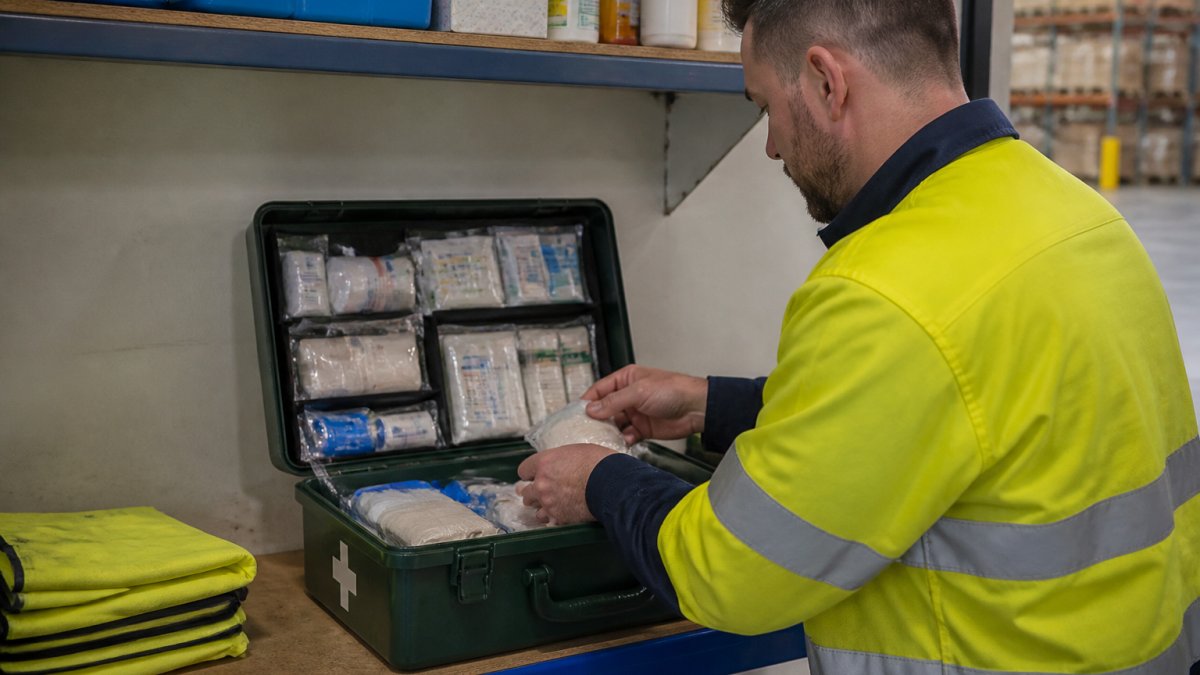
Kit contents typically include:
- Adhesive dressings in assorted sizes
- Sterile gauze swabs and non-adherent dressings
- Crepe and conforming bandages
- Triangular bandages and safety pins
- Disposable gloves, eye protection, and resuscitation mask
- Saline solution for eye and wound irrigation
- Thermal blanket and scissors
Beyond the kit, you need first aid facilities: a designated area for treatment, access to washing facilities, and a clear route to medical assistance.
First Aid Certificate Renewal in the Workplace: Keeping Staff Current
First aid certificates in Australia are valid for three years, and CPR refreshes annually. That mismatch is where most compliance gaps appear: a worker’s certificate looks current, but their CPR component lapsed months ago.
Track both dates separately. A first aid certificate renewal in the workplace should trigger a CPR refresher booking, not just a certificate update. If you wait for the three-year mark to act, you will have staff on site with expired CPR skills.
First Aid Training Records Template and Audit Evidence
Training records are the evidence that turns a policy into a defence. A regulator does not want to see your intentions; they want to see who was trained, when, by whom, and what they covered.
A first aid training records template should capture:
- Worker name and role
- Course name and unit codes completed
- Training provider and RTO number
- Date completed and certificate expiry
- CPR refresh due date
- Copy of the certificate on file
- Site or shift the worker covers
Pair this with kit inspection logs and your risk assessment review dates. Three documents, reviewed on a schedule, cover the bulk of what an audit looks for.
State and Territory Differences in First Aid Compliance
The model framework is national. The regulator is not. Each state and territory has its own work health and safety authority, its own guidance material, and in some cases its own requirements for first aid coverage, incident notification, and recordkeeping. This is the section most multi-jurisdiction employers get wrong, because a policy written against the model Code will usually satisfy the spirit of the law but not always the letter of it.
The regulators you are actually dealing with
|
Jurisdiction |
Primary WHS regulator |
|---|---|
|
New South Wales |
SafeWork NSW |
|
Victoria |
WorkSafe Victoria |
|
Queensland |
WorkSafe Queensland |
|
Western Australia |
WorkSafe WA |
|
South Australia |
SafeWork SA |
|
Tasmania |
WorkSafe Tasmania |
|
Australian Capital Territory |
WorkSafe ACT |
|
Northern Territory |
NT WorkSafe |
|
Commonwealth |
Comcare |
Each of these bodies publishes its own first aid guidance, its own incident notification categories and timeframes, and its own inspection priorities. The model Code gives you the shape of a compliant program. The local regulator tells you what evidence they will ask for and how quickly they expect to be notified of a serious incident.
Where the differences actually bite
Three areas account for most of the variation an employer will encounter.
Incident notification. The categories of incident that must be notified, and the timeframe for notifying them, are set jurisdiction by jurisdiction. A procedure built on one regulator’s timeframe will not automatically satisfy another.
First aid coverage expectations. The model Code sets indicative ratios by risk level, but regulators differ in how prescriptively they apply them and how much weight they give to distance from medical assistance, shift patterns, and lone work.
Industry-specific rules. Some sectors, construction, mining, maritime, and certain high-hazard processing environments, carry additional first aid requirements layered on top of the general framework.
A practical way to build a multi-jurisdiction program
Start with the model Code as your base layer, because it is the common denominator every jurisdiction recognises.
That annex is the document that turns a generic national policy into something an inspector in any jurisdiction can recognise as locally compliant. It also gives you a review trigger: when a regulator refreshes its guidance, you update one annex rather than rewriting the whole program.
For most businesses, the differences are manageable once they are written down. The failure mode is not complexity, it is assuming the model framework travels unchanged into every jurisdiction you operate in.
Frequently Asked Questions
What are the workplace first aid requirements for 2026?
The core duties remain the same: provide accessible first aid facilities, trained first aiders, and a stocked kit proportionate to your risk level. In 2026, compliance attention is on documented risk assessments, evidence of training and renewal, and coverage for remote or multi-site workers. Each state and territory regulator publishes its own Code of Practice, so check the code that applies to your jurisdiction and keep records that show you followed it.
How many first aiders does a workplace need?
There is no single national number. The model Code of Practice of Practice suggests at least one trained first aider for low-risk workplaces with 10 to 50 workers, and at least one for every 25 workers in high-risk settings, but your risk assessment decides the final figure. Consider shift patterns, leave, multiple sites, and how far workers are from medical help. Document the reasoning so a regulator can see how you arrived at your number.
How often should workplace first aid certificates be renewed?
Most workplace first aid certificates, including HLTAID011 Provide First Aid, are valid for three years, but the CPR component must be refreshed every 12 months. Many employers set renewal reminders at 11 months to avoid lapses. If a certificate expires, the worker is no longer a qualified first aider on paper, which can leave a gap in your coverage. Track expiry dates centrally rather than relying on staff to remember.
What should a workplace first aid kit contain?
Contents depend on your risk assessment and industry. A basic kit typically includes adhesive dressings, sterile gauze, bandages, a resuscitation mask, gloves, scissors, saline, and a first aid guide. High-risk sites may need burns dressings, eye wash, splints, or a defibrillator nearby. Check your kit against the current national list and your state code, inspect it regularly, and replace anything used or expired. Keep a written record of each inspection.
Does every workplace need a first aid room?
No. A dedicated first aid room is usually required only where the risk assessment identifies a need, such as high-risk sites, larger workplaces, or where workers are far from medical services. Low-risk offices may meet their duty with a clearly signed first aid area, a stocked kit, and trained staff. The deciding factor is whether injured workers can be treated promptly and privately, so document why your arrangement is adequate.
How can a business keep track of staff first aid qualifications?
Use a simple register that lists each first aider’s name, qualification code, issue date, expiry date, and CPR renewal date. A spreadsheet works for small teams; larger or multi-site operations benefit from a system that sends automatic reminders. Review the register monthly, book refreshers before expiry, and keep certificates on file as audit evidence. This turns renewal from a scramble into a scheduled task.
Recent Comments