

Table of Contents
- Why Hands On First Aid Skills Training Beats Online-Only Courses
- What You’ll Need Before Your Hands On First Aid Skills Training
- Step 1: Check Your Workplace First Aid Certification Requirements
- Step 2: Understand First Aid Course Duration and Assessment
- Step 3: Book Mobile First Aid Training for Businesses and Groups
- Step 4: Practise the Core Skills Competitors Skip
- Common Mistakes to Avoid in Hands On First Aid Skills Training
- Frequently Asked Questions
Last Updated: October 2, 2026
Why Hands On First Aid Skills Training Beats Online-Only Courses
Skills decay fast when you never rehearse them. A first aid certificate earned entirely through a screen can leave you hesitating over a manikin in a real emergency, because reading about chest compressions is nothing like finding the right hand position under pressure. Hands on first aid skills training closes that gap by making you physically perform every technique until it becomes automatic.
In this guide, the Provide First Aid Gold Coast team walks through exactly how to arrange practical training, what to expect on the day, and which skills matter most. Below, we’ll show you how to book, prepare, and get real confidence out of your course.
The core argument is simple: knowledge fades, but practised movement sticks. If your team needs nationally recognised competency standards, the practical component is where competence is actually built.
What You’ll Need Before Your Hands On First Aid Skills Training
Nothing complicated, but a little preparation makes the day smoother. Most providers supply all first aid equipment, including manikins, training defibrillators, bandages and epinephrine trainers, so you only need to bring yourself and the right mindset.
- Comfortable clothing you can kneel and move in
- Photo identification for your certificate
- A willingness to participate in practical assessment
- Any language or accessibility needs flagged in advance
- A list of your team’s current certificate expiry dates
If you are organising for a group, gather names, roles and existing certification dates beforehand. This saves time on the day and helps the trainer pitch the session at the right level.
Step 1: Check Your Workplace First Aid Certification Requirements
Workplace first aid certification requirements are set by your state or territory WHS regulator, not by your training provider.
Under the model WHS laws, businesses must provide adequate first aid facilities, trained personnel and access to first aid equipment. The exact number of first aiders depends on your workforce size, the type of work, and how far you are from medical help.
Check your regulator’s first aid code of practice directly, because it lists the specific factors inspectors look at.
Step 2: Understand First Aid Course Duration and Assessment
First aid course duration and assessment vary by unit, but the full Provide First Aid course typically runs across one day of face-to-face delivery, while a standalone CPR refresher takes around two to three hours. Blended learning, where you complete theory online and attend for the practical component only, can shorten the in-person time.
Assessment is competency-based. That means you are not graded on a percentage, you are judged as either competent or not yet competent against each performance criterion. Expect to demonstrate:
- Unresponsive breathing casualty: CPR on a manikin at the correct rate and depth
- Choking casualty: back blows and chest thrusts on a training manikin
- Bleeding control: applying direct pressure and a pressure bandage
- Recovery position: rolling a casualty safely
- Defibrillator usage: applying pads and following prompts
The trainer watches, coaches and re-tests where needed. Nobody fails for struggling on the first attempt; they keep practising until the technique is right.
Step 3: Book Mobile First Aid Training for Businesses and Groups
Mobile first aid training for businesses removes the biggest barrier to getting a team certified: the logistics.
This matters most for teams spread across multiple locations or shift patterns.
Provide First Aid Gold Coast delivers exactly this model: mobile training that comes to your location, with all equipment provided and trainers who bring real first aid and CPR experience.
Pricing depends on group size, location, dates and which units you need, so the fastest path is to call and get a quote tailored to your team.
Step 4: Practise the Core Skills Competitors Skip
Most courses rush the practical work and spend too long on slides. The skills that actually save lives are the ones you rehearse repeatedly, so insist on a session that gives you real repetitions rather than a demonstration.
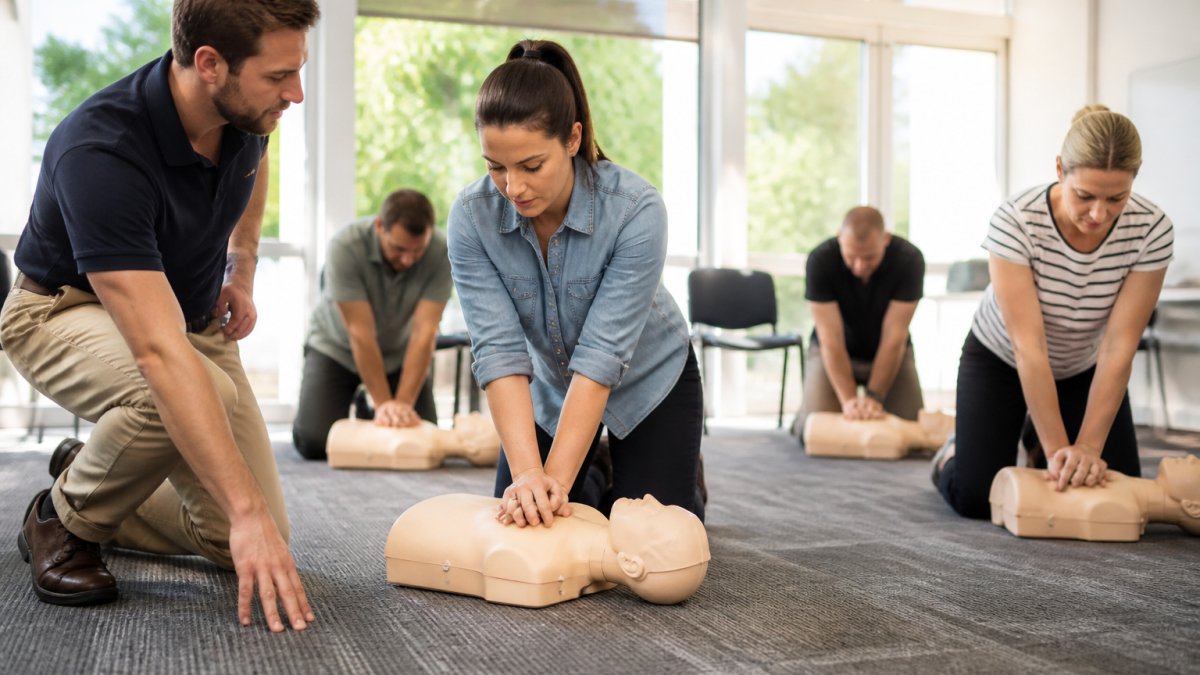
Prioritise these five, which cover the majority of real emergencies:
- CPR technique. Correct hand placement on the lower half of the sternum, compressions at 100-120 per minute, one-third of chest depth, with full recoil between compressions and minimal interruptions. On an adult manikin that is roughly 5-6 cm deep; on a child, about one-third of the chest depth; on an infant, two fingers or two thumbs encircling the chest. Ask your trainer to watch your recoil specifically, leaning on the chest is the most common silent failure.
- Defibrillator usage. Pad placement (right shoulder to left lower ribs, or anterior-posterior if the casualty has a pacemaker), following voice prompts, and clearing everyone before the shock. Practise the pause: stop compressions, check nobody is touching the casualty, deliver the shock, resume immediately. The gap between shock and resumed compressions should be seconds, not minutes.
- Anaphylaxis management. Recognising a severe allergic reaction (swelling of the face or throat, difficulty breathing, widespread hives, collapse) and using an adrenaline autoinjector correctly into the outer mid-thigh. Note that a casualty may need a second dose after five minutes if there is no improvement, practise the sequence, not just the injection.
- Bleeding control. Direct pressure with a dressing, elevation where appropriate, and a pressure bandage for soft tissue injuries. For severe limb bleeding that will not stop, a tourniquet applied high and tight, with the time recorded, is now standard practice. Practise applying one to a training limb so the motion is familiar.
- Recovery position. Rolling a casualty onto their side with the upper leg bent to stabilise them, head tilted slightly back to keep the airway clear, and the mouth angled downward so fluids drain. Rehearse on both sides, real casualties are not always cooperative.
Child and infant emergency care deserves separate attention if you work with young people. Compression depth and technique differ significantly, and infant CPR in particular is a skill most people have never practised.
The skill competitors skip: psychological preparation
Every course page lists the physical skills. Almost none prepare you for the freeze response, the involuntary hesitation that hits many people the first time they face a real casualty.
The practical fix is scenario rehearsal with pressure. Ask your trainer to run a scenario with noise, bystanders calling out, and a casualty who is not lying neatly on a mat.
Home kit audit versus workplace kit
Most course pages tell you to check your first aid kit but never say what should be in it. The contents differ by setting, and getting this wrong is common.
A workplace kit is governed by your state or territory WHS regulator’s first aid code of practice, which sets out what must be provided based on your hazards, workforce size and distance from medical help.
After training, audit both kits against what you actually practised. Training is wasted if the pressure bandage you learned to apply is missing or out of date.
Common Mistakes to Avoid in Hands On First Aid Skills Training
The biggest error is choosing a course on price and convenience alone. A cheap online-only certificate may satisfy a booking system but leave your team unable to act. Regulators and insurers increasingly look at whether training was practical and recent.
Other mistakes worth avoiding:
- Letting certificates lapse. CPR refreshes are typically recommended annually, with full first aid renewal every three years. Diarise expiry dates for every staff member, and set a reminder 60 days out so you have time to book.
- Training too few people. If your only first aider is on leave, you have no first aider. Train enough to cover shifts, leave and absences, a common rule of thumb is at least two trained first aiders per shift in higher-risk settings.
- Skipping scenario practice. Real emergencies are messy. Practising with distractions, noise and bystanders builds the composure that matters.
- Forgetting the first aid kit audit. After training, check your kit is stocked, in date and accessible. Training is wasted if the defibrillator battery is flat.
The mistake nobody talks about: post-incident trauma support
Most training ends when the manikin is packed away.
A common pattern after administering first aid is intrusive thoughts, disrupted sleep, guilt about what you did or did not do, and a reluctance to talk about it because “someone else had it worse”.
What helps:
- A structured debrief within 24-48 hours. Not a blame session, a chance to walk through what happened, what was done, and what could be improved. Keep it factual and supportive.
- Naming the reaction. Telling a responder “what you are feeling is a normal response to an abnormal event” reduces shame and isolation.
- Access to support. Most workplaces have an Employee Assistance Program, and beyond that, a GP can provide a mental health care plan with subsidised sessions. Lifeline (13 11 14) and Beyond Blue (1300 22 4636) are available around the clock.
- Time and check-ins. A follow-up conversation a week later often matters more than the immediate debrief.
Looking after the responder is part of a complete safety culture. A team that knows it will be supported after a critical incident is a team more willing to act during one.
The mistake that undermines everything: no rehearsal after certification
A certificate is a snapshot, not a skill. Without rehearsal, CPR compression quality degrades measurably within months, depth becomes shallow, rate drifts, and interruptions lengthen. The fix is simple: run a 15-minute skills refresher every quarter using a manikin and a defibrillator trainer. It does not need to be a formal course. It needs to be regular, hands on, and corrected by someone who knows what good looks like.
Frequently Asked Questions
Why is hands-on training better than online-only first aid courses?
Online courses cover the theory, but you cannot build muscle memory from a screen. Hands on first aid skills training has you kneel beside a manikin, practise compressions to the correct depth, and run through recovery positions and bandaging until the steps feel automatic. That repetition is what holds up when a real emergency happens, because you are copying a movement you have already done rather than recalling a video. Blended learning works best when the practical assessment is done in person.
How often should workplace first aid training be refreshed?
Most Australian workplaces refresh their first aid certification every three years, with CPR refreshers recommended annually. Safe Work Australia expects that staff can respond effectively at all times, so skills need to stay current rather than just valid on paper. A practical approach is to book a full course every three years and run a short CPR and defibrillator session each year in between. That rhythm keeps skill retention high without disrupting your roster.
What practical skills are covered in a standard first aid course?
A standard course covers CPR techniques for adults, children and infants, defibrillator usage, the recovery position, choking relief, bleeding control, burn treatment, fractures and soft tissue injuries, plus anaphylaxis and asthma response. You also practise patient assessment, airway management, triage and incident reporting. The point of hands on first aid skills training is that every one of these is performed, not just described, so your team leaves knowing what to do with their hands.
Does workplace first aid training meet Safe Work Australia requirements?
Safe Work Australia’s model Code of Practice on First Aid in the Workplace sets out what a business needs to assess and provide, and the training you book should be nationally recognised and delivered by an accredited provider. Check that the course covers casualty management, life support and emergency response, and that your certificates show the correct units of competency. Confirm the provider’s RTO registration before you book so your compliance records stand up.
Recent Comments