
Last Updated: November 2, 2026
Quick Summary
Most Australian workplaces need HLTAID011 Provide First Aid as their baseline first aid certification, because it covers CPR, defibrillation, bleeding control, burns, fractures, choking and allergic reactions. Lower-risk sites may use HLTAID009 CPR-only training for refreshers, but that decision belongs to your risk assessment.
- HLTAID010 covers CPR and basic life support but stops short of the broader injury management in HLTAID011.
- There is no single legislated ratio for first aiders; the Code of Practice guides a risk-based calculation.
- Many first aid qualifications are generally recognised for three years, while CPR skills are commonly refreshed every 12 months.
- Set reminders at 60 and 30 days before expiry so there is time to book without a rushed reschedule.
- Verify any RTO through the national training register before paying a deposit.
Table of Contents
- Which First Aid Certification Actually Fits Your Workplace
- Workplace First Aid Training Requirements Under Australian WHS Law
- HLTAID011 vs HLTAID010 vs HLTAID009: Course Comparison
- How Many First Aiders Does a Workplace Need?
- First Aid Refresher Course Frequency and Renewal Planning
- Onsite Workplace First Aid Training: What to Expect
- How to Check a Course Is Nationally Recognised and a Provider Is Worth Booking
- Book Onsite First Aid Certification for Your Team
- Frequently Asked Questions
Which First Aid Certification Actually Fits Your Workplace
Choosing the best first aid certification for workplaces starts with one question: what does your risk profile actually demand? Most Australian workplaces need HLTAID011 Provide First Aid as the baseline.
At Provide First Aid Gold Coast, we deliver mobile, on-site training for construction crews, childcare centres, sporting clubs and electrical contractors.
Below, we break down how the three core units differ, how many first aiders you need, how often certificates expire, and how to check a provider is genuinely nationally recognised. Here is the short version up front:
|
Unit |
Covers |
Typical workplace use |
|---|---|---|
|
HLTAID011 Provide First Aid |
CPR plus injury and illness response |
Default for most workplaces |
|
HLTAID010 Provide Basic Emergency Life Support |
CPR plus basic life support |
Lower-risk or supplementary roles |
|
HLTAID009 Provide CPR |
CPR and defibrillation only |
Annual CPR refresher, low-risk sites |
That table is the decision in miniature. The rest of this guide explains the reasoning.
Workplace First Aid Training Requirements Under Australian WHS Law
Your actual obligation is to assess risk and provide adequate first aid. Safe Work Australia publishes a First Aid in the Workplace Code of Practice that explains how to do that assessment.
A common mistake is treating “we have a first aid kit” as compliance. It is not. The kit is one input; trained people are the other, and inspectors ask about both.
HLTAID011 vs HLTAID010 vs HLTAID009: Course Comparison
The three units sit on a ladder of scope, and the differences matter more than most course pages admit. What most guides do not give you is a way to map a role to a unit without reading three separate course outlines. The matrix below does that.
HLTAID011 Provide First Aid
HLTAID011 is the broadest of the three and the one most workplaces should default to. It covers CPR, defibrillation, bleeding control, burns, fractures, choking, allergic reactions and managing an unconscious casualty until help arrives. It is the unit childcare, construction and most general workplaces rely on.
HLTAID010 Provide Basic Emergency Life Support
HLTAID010 covers CPR and basic life support but stops short of the broader injury management in HLTAID011. It suits lower-risk environments or roles where someone else on site holds the fuller qualification.
HLTAID009 Provide CPR
HLTAID009 is CPR and defibrillation only. It is the unit people renew annually, and it is genuinely sufficient for some low-risk settings. What most guides miss is that HLTAID009 does not cover bleeding control or injury management, so it is rarely enough as a site’s only qualification.
Role-based decision matrix
Use this as a starting point, then confirm against your risk assessment and any industry-specific rules. The right-hand column is the unit most practitioners would book for that role; the middle column explains why.
|
Role or setting |
Why this unit fits |
Unit to book |
|---|---|---|
|
General office, retail or professional services with low physical hazard |
Baseline injury and illness response; one or more staff should hold the fuller qualification |
HLTAID011 for designated first aiders; HLTAID009 for annual CPR refreshers |
|
Construction, trades, manufacturing or warehousing |
Higher risk of bleeding, fractures, burns and crush injuries; broader injury management is needed |
HLTAID011 |
|
Childcare, early learning or schools |
Duty of care extends to children and visitors; allergic reactions and choking are common |
HLTAID011 |
|
Sporting clubs, gyms and recreation |
CPR and defibrillation are the priority; injury management is also likely |
HLTAID011, with HLTAID009 for annual CPR refreshers |
|
Remote, isolated or lone-worker sites |
Emergency services may be delayed; staff need to sustain a casualty |
HLTAID011, plus extra first aiders to cover shifts |
|
Low-risk site where a fuller-qualified first aider is always on shift |
Supplementary CPR coverage is enough for secondary responders |
HLTAID010 or HLTAID009 |
Two rules of thumb keep this simple. First, if a role could plausibly encounter bleeding, burns, fractures or an unconscious casualty, book HLTAID011. Second, treat HLTAID009 as a refresher and supplementary unit, not as a substitute for the broader qualification on a site with any real injury risk.
What the units do not tell you
Unit codes describe the skills assessed, not the quality of the training. Two providers can deliver the same HLTAID011 with very different amounts of hands-on practice, scenario work and trainer experience. When you compare courses, compare practice time per participant and assessment rigor alongside the unit code.
How Many First Aiders Does a Workplace Need?
There is no single legislated ratio. The Code of Practice guides you through a risk-based calculation rather than a fixed formula.
A practical approach we recommend:
- Map your highest-risk tasks and where they happen
- Check emergency service response times to each site
- Factor in shift patterns, leave and turnover so cover never drops to zero
- Account for lone workers and remote or isolated tasks
- Confirm any industry-specific ratios that apply to your sector
The number that matters is not “how many certificates exist” but “how many trained people are on shift at any given moment”. Two qualified staff on a site with three shifts is a gap, not compliance.
First Aid Refresher Course Frequency and Renewal Planning
First aid refresher course frequency is where compliance quietly collapses. Many first aid qualifications are generally recognised for three years, while CPR skills are commonly refreshed every 12 months, so check the validity of each unit against your provider and your regulator’s requirements.
A workable approach is a rolling calendar rather than a single bulk booking. Staggering renewals across the team helps avoid losing coverage in any one month.
A workforce-wide renewal system that survives an audit
Most guides stop at “renew every three years”. That is not a system. A workable renewal plan has four parts:
- A single register. One record per person, not per course. Minimum columns: name, role, site or location, unit code, completion date, CPR due date, certificate expiry date, and a copy of the certificate stored against the record.
- Coverage checks, not just expiry checks. Before you book a refresher, confirm how many trained people remain on each shift and site while that person is away. A renewal that leaves a shift uncovered is a scheduling problem disguised as a training problem.
- Staggered booking windows. Spread renewals across the year so no single month loses a large share of qualified staff. Where CPR is due annually, book it alongside the broader refresher where the provider allows, rather than as a separate disruption.
- Reminders at 60 and 30 days. Set calendar or system reminders well before expiry so there is time to book, travel or arrange onsite delivery without paying for a rushed reschedule.
What to record and why
Auditors and inspectors typically ask who is trained, in what, and until when. A register that answers those three questions in one view is usually enough.
For smaller teams, a shared spreadsheet with the columns above is sufficient. For larger or multi-site operations, a compliance platform earns its keep by automating reminders and coverage reporting, but the discipline of maintaining the register matters more than the tool.
Renewal timing and cost trade-offs
Renewing early is usually cheaper than renewing late. Late renewals force rushed bookings, travel to whatever course has space, and staff time away from work at short notice.
One more point most guides miss: the CPR component and the broader first aid qualification can fall due at different times. Track them as separate dates in the register, or you will eventually discover a team that is current for first aid but overdue for CPR.
Onsite Workplace First Aid Training: What to Expect
Onsite workplace first aid training removes the logistics problem entirely: the trainer, manikins, bandages and defibrillator trainers come to your site, and your team trains in familiar surroundings.
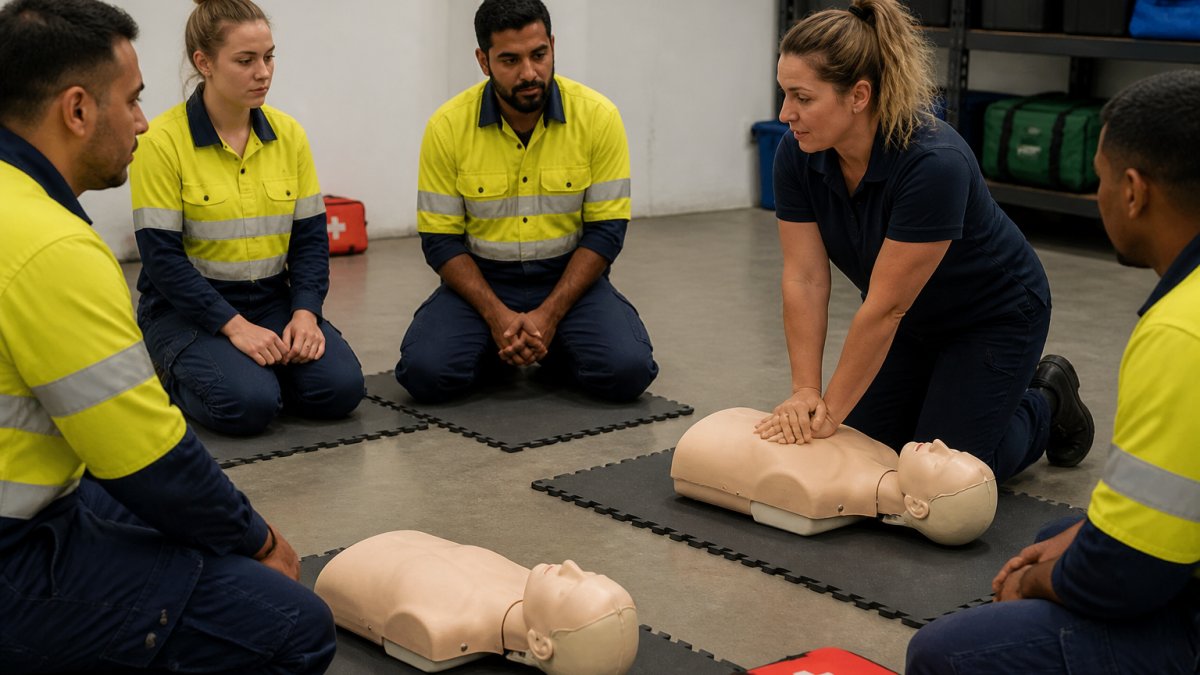
A typical session runs as a mix of demonstration, hands-on practice and scenario work. Participants kneel on mats and perform compressions, practise bandaging, and talk through realistic incidents.
Provide First Aid Gold Coast brings all training equipment and experienced trainers to your location, so teams can train on site. D.
How to Check a Course Is Nationally Recognised and a Provider Is Worth Booking
A certificate is only worth the paper it is printed on if the provider is legitimate. Nationally recognised training must be delivered by a registered training organisation, and you can verify any RTO through the national training register before you pay a deposit.
Use this checklist when evaluating a provider:
- Confirm the RTO registration is current and covers the exact unit codes
- Ask what equipment is used and how much hands-on practice each participant gets
- Check how assessment is conducted and what happens if someone does not pass
- Confirm the certificate is issued promptly and includes the unit codes
- Ask about trainer experience and currency in real emergency settings
Training quality varies between providers, and practice time per person is worth comparing alongside price. For a practical comparison, the Australian Skills Quality Authority regulates the sector and publishes guidance on what learners should expect. Ask blunt questions. A good provider welcomes them.
Book Onsite First Aid Certification for Your Team
The gap between a compliant workplace and a confident one comes down to practice, not paperwork.
If you are weighing up the best first aid certification for workplaces, start with your risk assessment, confirm the unit codes you need, and book training that fits around your operations rather than disrupting them.
Provide First Aid Gold Coast is a training partner of Healthcorp (RTO ID 91222) and delivers mobile first aid and CPR training to your site, with all training equipment provided and experienced trainers.
Frequently Asked Questions
What first aid certificate do employees need for the workplace?
Most workplaces nominate HLTAID011 Provide First Aid as the standard qualification for designated first aiders, because it covers CPR plus bleeding, burns, fractures, asthma, anaphylaxis and other common injuries. Where a risk assessment shows a lower risk profile and CPR-only coverage is enough, HLTAID009 Provide CPR can suit staff who support a trained first aider. Your state or territory WHS regulator and industry code of practice set the minimum, so confirm the requirement before booking.
How often should workplace first aid training be refreshed?
CPR skills are commonly refreshed every 12 months, and first aid qualification validity periods should be confirmed against the current requirements of your regulator and provider. Build both dates into your compliance calendar so no staff member lapses, and rebook the whole cohort at once to avoid chasing individuals.
Can workplace first aid training be delivered onsite?
Yes. Onsite workplace first aid training brings the trainer, manikins, AED trainers and consumables to your site, so staff train in familiar surroundings without travel time or lost coverage. It suits teams spread across multiple locations. Ask the provider how they handle room requirements, floor space for practical work and scheduling around shifts before you confirm dates.
How do I check whether a first aid course is nationally recognised?
Look for a statement that the course is delivered by a registered training organisation and check the RTO’s ID number on the national register at training.gov.au. The units should be listed by their national codes, such as HLTAID011, HLTAID010 and HLTAID009. If a provider cannot show an RTO ID or the units do not appear on the register, the certificate will not meet workplace requirements.

Recent Comments