
Last Updated: November 1, 2026
Quick Summary
First aid training for childcare staff must meet the National Quality Framework, and the exact requirements are set by each state and territory regulator. Staff in approved education and care services need HLTAID012, the education and care specific unit, because a general first aid certificate alone does not meet the requirement. A qualified staff member must also be on site and available at all times, including during excursions and rest periods.
- HLTAID012 is the nationally recognised unit titled Provide First Aid in an Education and Care Setting.
- Ask for the RTO code before booking; Provide First Aid Gold Coast trains as a partner of Healthcorp, RTO ID 91222.
- Your service needs a current asthma care plan for every child with the condition, kept where staff can reach it.
- Hold a current ASCIA action plan for every at-risk child, and make sure it travels with the child on excursions.
- Keep one shared register of unit codes and expiry dates, with a reminder set 90 days out.
Table of Contents
- What Childcare First Aid Requirements Apply to Your Service
- HLTAID012 Explained: The Qualification Behind Childcare First Aid
- Paediatric First Aid Training: What Staff Actually Learn
- Childcare Anaphylaxis Training: Recognising and Responding to Allergic Reactions
- On-Site First Aid Training for Childcare Centres: How Delivery Works
- HLTAID012 vs General First Aid: Which Qualification Do Educators Need
- Renewal, Currency and Refresher Planning for Education Staff
- Booking First Aid Training for Your Childcare Team
- Frequently Asked Questions
What Childcare First Aid Requirements Apply to Your Service
First aid training for childcare staff is not optional in any approved education and care service. Under the National Quality Framework, services are required to have staff with current approved first aid qualifications, and the exact requirements are set by each state and territory regulator. The exact staffing ratios and qualification mix are set by each state and territory regulator, so the requirements your service follows depend on where you operate.
The practical starting point is your service’s own policies, which should name the qualifications required for each role. A common gap is a staff member who holds a general first aid certificate but not the education and care specific unit, which does not meet the requirement.
Three things determine what your service actually needs:
- The qualification unit: HLTAID012 is the education and care specific course. A general Provide First Aid certificate alone does not meet the requirement.
- The coverage rule: a qualified staff member must be on site and available at all times, including during excursions and rest periods.
- The currency rule: certificates expire, and an expired certificate is treated as no certificate.
Relying on one qualified staff member across a shared campus or multiple rooms creates a compliance gap if that person is on leave or off the floor.
HLTAID012 Explained: The Qualification Behind Childcare First Aid
HLTAID012 is the nationally recognised unit titled Provide First Aid in an Education and Care Setting. It is the qualification regulators expect educators, teachers and support staff to hold, and it combines standard first aid and CPR content with child-specific material that general courses leave out.
The unit is delivered through registered training organisations. Ask for the RTO code before you book anything. Provide First Aid Gold Coast delivers training as a partner of Healthcorp, RTO ID 91222.
HLTAID012 differs from a generic course in its context, with scenarios built around education and care settings.
Paediatric First Aid Training: What Staff Actually Learn
Paediatric first aid training covers the emergencies most likely to occur in a childcare setting, and the content is deliberately different from adult first aid. Children’s bodies respond differently, the techniques differ, and the confidence gap between knowing something and doing it under pressure is wider than most people expect.
Infant and Child CPR
Infant and child CPR is the core practical skill, and it is where most staff feel least confident before training. The technique differs by age: the ratio of compressions to breaths, the depth of compression, and the hand position all change between an infant and an older child.
Asthma and Common Childhood Emergencies
Asthma and common childhood emergencies make up the rest of the practical content.
The asthma component is where documentation matters as much as technique. Your service needs a current asthma care plan for every child with the condition, and staff need to know where it is kept. A plan locked in an office is not a plan.
Childcare Anaphylaxis Training: Recognising and Responding to Allergic Reactions
Anaphylaxis awareness is a key part of childcare first aid, and staff who supervise children should be trained to recognise the signs of a severe allergic reaction.
Recognition is the hard part. Anaphylaxis does not always look dramatic at the start.
Your service should hold a current ASCIA action plan for every child at risk, and the plan should travel with the child. Excursions are the highest-risk activity because the plan, the medication and the trained staff member all need to move together.
On-Site First Aid Training for Childcare Centres: How Delivery Works
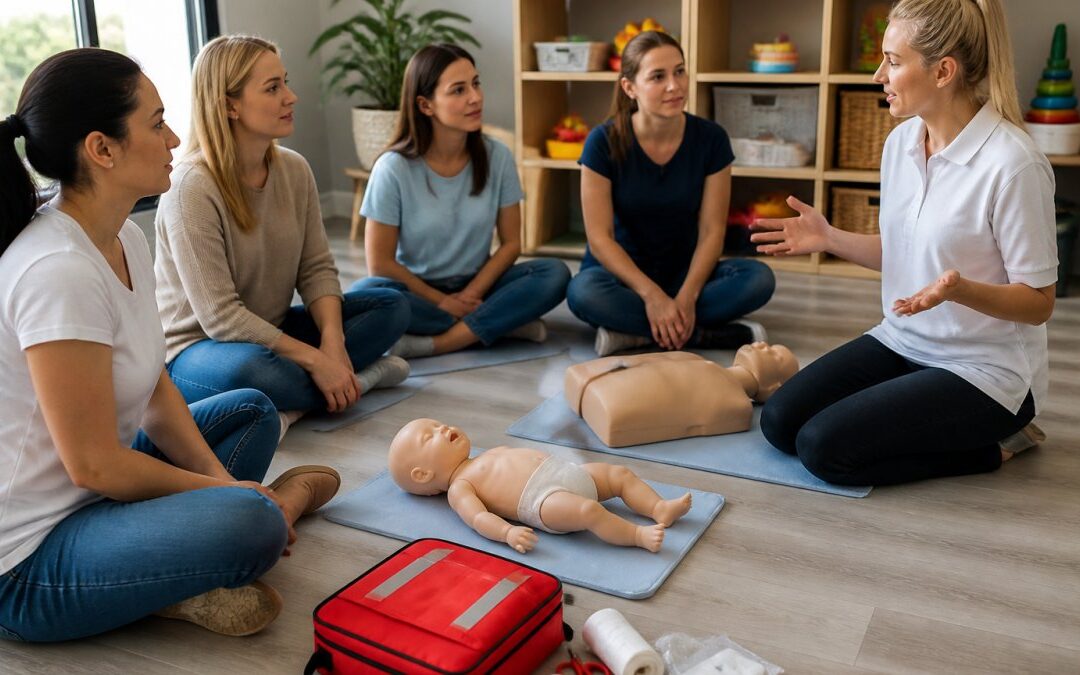
On-site first aid training for childcare centres brings the trainer and all equipment to your service, so staff train in the rooms they actually work in.

Scheduling sessions around your roster is important. We bring all training equipment to your location.
HLTAID012 vs General First Aid: Which Qualification Do Educators Need
Educators and support staff in an approved education and care service need HLTAID012, not a general first aid certificate. The general Provide First Aid unit covers adult-focused content and does not include the child-specific assessment your regulator expects. Booking the wrong course is an expensive mistake, because the certificate will not satisfy an assessment visit.
The distinction is not just about content. The two units differ in assessment conditions, and that difference is what regulators check.
|
Qualification |
Child-specific content |
Assessment focus |
Meets education and care requirement |
Best for |
|---|---|---|---|---|
|
HLTAID012 |
Yes, including infant and child CPR, asthma and anaphylaxis in an education and care context |
Scenario-based assessment in a simulated education and care setting |
Yes |
Educators, teachers, support staff who supervise children |
|
General first aid (Provide First Aid) |
No, adult-focused |
Adult casualty scenarios |
No |
General workplaces, trades, hospitality |
|
CPR refresher only |
No |
Adult CPR only |
No |
Maintaining currency between full courses |
|
Anaphylaxis and asthma management (standalone) |
Condition-specific |
Autoinjector and puffer administration |
Only as a supplement, not a substitute |
Staff who already hold HLTAID012 and need the add-on units |
Check the unit code on every certificate, not just the expiry date.
A senior educator with only a general first aid certificate cannot cover the room unless they also hold HLTAID012.
Renewal, Currency and Refresher Planning for Education Staff
First aid certificates expire, and renewal planning is where well-run centres separate from reactive ones. Check the currency period and refresher requirements for HLTAID012 with your regulator. An expired certificate means the staff member is not qualified, even if they have held the qualification for a decade.
The practical fix is a simple register. List every staff member, their unit code, their issue date and their expiry date, then set a reminder 90 days out. Chasing renewals manually across a team of 30 is how gaps appear.
A register only works if it is structured. At minimum, capture:
- Staff name and role
- Unit code held (HLTAID012, general first aid, CPR only)
- Issue date and expiry date
- Anaphylaxis and asthma management currency, if held separately
- Date of last CPR refresher
- Date the next renewal was booked
Three habits keep a service compliant:
- Track expiry dates in one shared register, not individual files
- Book refresher sessions a full term before expiry
- Confirm the unit code on every new certificate before filing it
State and territory regulators set their own requirements for how often qualifications must be renewed and what evidence must be kept on site. The national unit is consistent, but the compliance evidence a service must produce at assessment can vary by jurisdiction. Check your regulator’s current guidance and keep a copy with your register, because requirements can change between assessment cycles.
National Quality Framework and regulator guidance
A realistic annual cycle looks like this: audit the register at the start of each year, book group refreshers for the quietest term, and run a mid-year check against new starters. That rhythm keeps a service ahead of expiry without scrambling.
Booking First Aid Training for Your Childcare Team
Booking first aid training for childcare staff comes down to three decisions: the right unit, the right delivery format, and a date that does not break your ratios. Get those right and the compliance side takes care of itself.
Start by auditing who holds what against your regulator’s coverage rule, then work out who needs HLTAID012, anaphylaxis and asthma training, or renewal.
Then choose delivery. On-site training keeps your team on the floor in their own environment. Pricing depends on group size, dates and delivery format, so call us to talk through your roster and book your course.
Frequently Asked Questions
What first aid training do childcare staff need?
Staff working in early childhood services generally need HLTAID012 Provide First Aid in an Education and Care Setting, which covers CPR for infants, children and adults plus asthma and anaphylaxis response. Check with your approved provider about the specific childcare first aid requirements that apply to each position, including whether CPR refreshers are needed annually.
How often should childcare staff renew first aid training?
Check with your regulator for the current validity period and refresher requirements for HLTAID012. Book refreshers ahead of expiry so no staff member works with lapsed training. Build a simple register of names, certificate numbers and expiry dates, and book refreshers a month or two ahead so room closures or illness don’t leave gaps in coverage.
Does childcare first aid training include CPR and anaphylaxis?
Yes. The education and care setting course combines CPR for infants, children and adults with first aid for common childhood injuries and illnesses. It also covers recognition and management of asthma and severe allergic reactions, including how to use an adrenaline autoinjector and when to call emergency services. This is why paediatric first aid training is usually delivered as one combined course rather than separate modules for childcare workers.
Can first aid training be delivered at a childcare centre?
Provide First Aid Gold Coast brings all training equipment to your service, so staff train in familiar surroundings. Ask us about scheduling options for your team.
What should childcare staff do if a child has a medical emergency?
Follow your service’s emergency plan: assess the child, send for the first aid kit and anaphylaxis or asthma plan, and call Triple Zero (000) for any life-threatening situation. Start CPR or administer an adrenaline autoinjector if trained and the situation requires it, and keep other children supervised and away from the scene. Afterwards, document the incident and notify the family and your approved provider as your policies require.
Compliance gaps rarely show up until an assessment visit or, worse, a real emergency. If your team’s certificates are close to expiry or you are unsure which unit your staff actually hold, we can help you map it out. Provide First Aid Gold Coast delivers nationally recognised training at your centre, with all equipment supplied, trainers who work in real emergency settings, and course delivery built to be understood rather than endured. Call us to book your course and get your team current.

Recent Comments