
Last Updated: October 26, 2026
Quick Summary
To organize workplace first aid, start with a risk assessment that identifies hazards, worker numbers and site conditions, then build kits, procedures and training around it. Safe Work Australia sets the national model framework and your state WHS regulator enforces the local version. Get the assessment right and everything else follows.
- Map hazards by role and work area, then mark where risks stack up as priority zones.
- Counting one first aider per site without checking shift coverage is the most common mistake.
- Write one-page procedures covering alarm, 000 call, scene care, escalation and handover.
- Name a primary and backup caller for every shift so the procedure never fails.
- Run a monthly visual kit check and record every inspection in a signed log.
Table of Contents
- Start With a Workplace First Aid Risk Assessment
- Build Your Workplace First Aid Kit Checklist
- Write Workplace First Aid Procedures Staff Can Follow
- Use a Workplace First Aid Incident Report Template
- Plan First Aider Coverage Across Shifts and Sites
- Set a Maintenance and Restocking Schedule
- Book On-Site First Aid Training for Your Team
- Frequently Asked Questions
Start With a Workplace First Aid Risk Assessment
A workplace first aid risk assessment is the process of identifying hazards, worker numbers and site conditions to decide how to organize workplace first aid equipment, training and people. At Provide First Aid Gold Coast, we tell every client the same thing: the kit is the last thing you buy, not the first.
Safe Work Australia sets the national model framework for first aid in the workplace, and your state WHS regulator enforces the local version. Start there, not with a supplier catalogue.
Walk each work area and ask three questions:
- What injuries could realistically happen here?
- How far is the nearest hospital or medical service?
- Who is on site, and when?
That last question is where most assessments fall apart. A hazard map that ignores shift patterns is just a poster.
Mapping Hazards by Role and Work Area
Different roles carry different risks. Map them separately.
Construction crews face cuts, crush injuries, eye damage and falls. Electricians face electric shock and burns, which is why low voltage rescue training sits alongside first aid. Office staff face slips, trips and strain injuries.
Draw a simple grid: work area down one side, hazard type across the top. Mark where risks stack up. Those are your priority zones for kit placement and trained staff.
How Many First Aiders Your Workplace Needs
There is no single national number. Safe Work Australia’s model guidance ties first aider numbers to workforce size and risk level, and your state regulator publishes the specifics.
A common approach is to treat high-risk sites differently from low-risk offices.
Watch out: counting “one first aider per site” without checking shift coverage is the most common mistake we see. If that person is on leave, you have nobody.
Build Your Workplace First Aid Kit Checklist
A workplace first aid kit checklist is a written list of every item your kits must hold, matched to your hazard profile and checked on a set schedule.
Matching Kit Contents to Your Hazard Profile
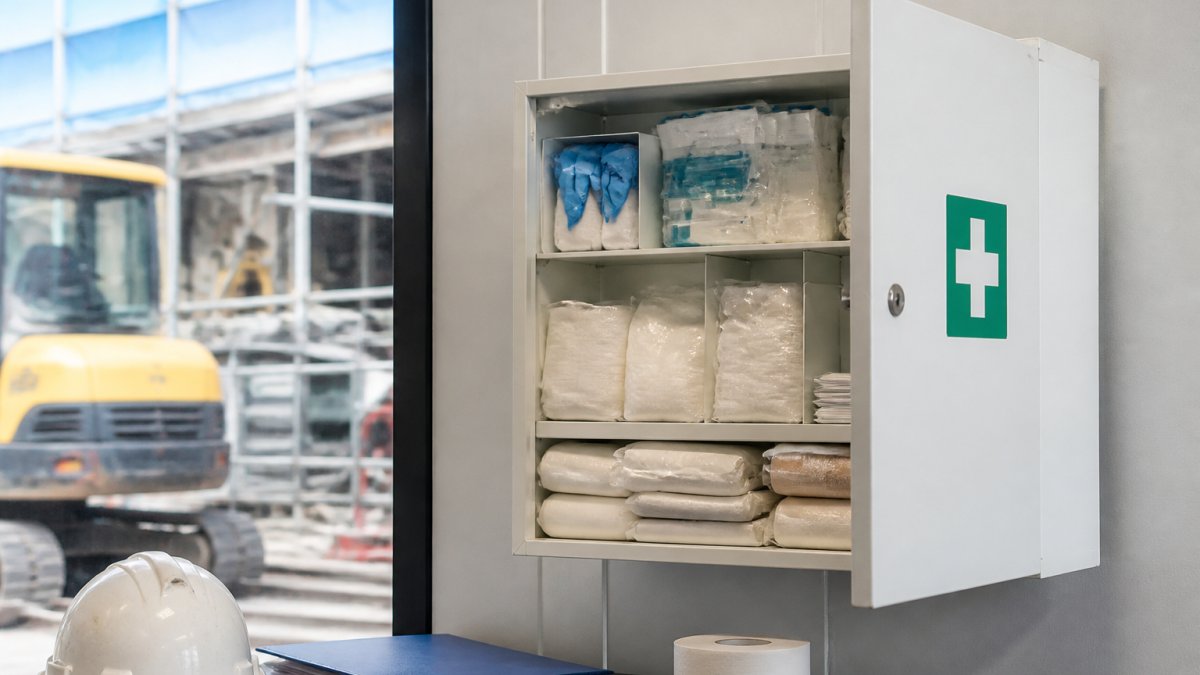
Standard kits cover the basics: bandages, gauze, adhesive tape, antiseptic wipes, disposable gloves, scissors and tweezers. Beyond that, match contents to your risks.
- Construction and mining: heavy-duty dressings, eye wash, burn gel, splints
- Electrical work: burn dressings and rescue equipment for low voltage incidents
- Childcare: child-sized dressings, choking aids, allergy response supplies
Keep the list in writing and store a copy with each kit. That way restocking is a tick-box job, not a memory test.
Placement, Signage and Accessibility
Kits must be easy to find and easy to reach. Put them near high-risk zones, not locked in a manager’s office.
- Mount kits at eye level where possible
- Add clear first aid signage with a green cross
- Display emergency contact information beside every kit
Accessibility matters more than tidiness. If a worker has to ask for a key, the kit is in the wrong place.
Write Workplace First Aid Procedures Staff Can Follow
Workplace first aid procedures are short written steps that tell staff exactly what to do when someone is injured. One page per scenario beats a fifty-page manual nobody reads, but the page has to cover the whole response, not just the first thirty seconds.
Cover the situations your risk assessment flagged. For each one, write a procedure that answers five questions in order:
- How to raise the alarm. Who is told first, by what method (radio channel, phone tree, PA, whistle), and what exact words are used. “First aider to bay three” is a procedure; “get help” is not.
- How to call emergency services. Triple Zero (000) is the number for police, fire and ambulance; 112 works from mobile phones. Nominate one person to call and one to meet the ambulance at the entrance, the caller stays on the line, the meet-and-greet unlocks the gate and clears the path.
- What to do at the scene while waiting. Immediate steps matched to the injury type, plus the universal rules: do not move a casualty unless there is immediate danger, do not remove embedded objects, and send for the kit and the nearest trained first aider by name.
- When to escalate. Clear triggers, loss of consciousness, difficulty breathing, chest pain, severe bleeding, suspected spinal injury, head injury with confusion, that mean call 000 immediately rather than monitor.
- How to hand over to responders. What to tell paramedics: what happened, when, what treatment was given and by whom, any known allergies or medications, and the casualty’s name and age. Keep the incident report and the kit log ready.
Managing the Scene and the Handover
A procedure that stops at “call an ambulance” leaves the hardest part to improvisation. Add a short scene-management block to every procedure:
- Control the area. Isolate the hazard (power down, stop machinery, cordon the spill) before treating the casualty, so responders do not become second casualties.
- Assign roles by name on the day. One person treats, one calls, one meets the ambulance, one manages the crowd and the paperwork. Write the roles into the procedure so they are assigned before an incident, not during one.
- Keep a timeline. Note the time of injury, the time 000 was called, the time treatment started and the time responders arrived. Paramedics ask for this and the incident report needs it.
Keep procedures with the kit, in the first aid room and in the site induction pack. Review them whenever the risk assessment changes, a new hazard is introduced, or an incident review shows the response did not go to plan.
Use a Workplace First Aid Incident Report Template
A workplace first aid incident report template is a standard form that captures what happened, who was involved, what treatment was given and what followed. It protects your workers and your business.
Include these fields:
- Date, time and location
- Names of the injured person and any witnesses
- Description of the injury and how it happened
Keep completed reports secure and review them monthly. Patterns matter: three similar cut injuries in a month point to a hazard, not bad luck. Under Australian WHS law, some incidents trigger mandatory notification to your regulator, so check the rules that apply to you before deciding a report stays internal.
Plan First Aider Coverage Across Shifts and Sites
Coverage is where compliance quietly breaks. A workplace can tick every box on paper and still have no trained first aider on the floor at 2am on a Sunday, or, increasingly, no plan at all for the worker alone in a home office, a service van or a remote field site.
Map your roster against your first aiders. Then answer:
- Does every shift have at least one trained first aider?
- What happens during leave, overtime and weekends?
- Who covers night shifts and remote sites?
For multi-site operations, treat each site as its own coverage problem. Shared first aiders across sites only work if travel time is short and the arrangement is written down.
Remote, Hybrid and Lone-Worker Arrangements
A central first aid room does nothing for a worker two hours from the nearest town or a hybrid employee alone at a home desk. Most first aid guidance assumes a shared site; the practical answer is a separate lone-worker plan layered on top of the site plan.
Build it around four controls:
- A check-in schedule. Every lone worker checks in at agreed times by phone, app or radio. A missed check-in triggers a call, then a welfare visit, not a note in a diary.
- A personal or vehicle kit. Issue a portable kit matched to the hazards of the role (vehicle, field, home office) and keep it on the same inspection schedule as the site kits.
- A named emergency contact and location protocol. The lone worker must be able to give a precise location, GPS coordinates, a what3words reference or a site address, to 000. Test that this works from the places people actually work.
For hybrid and home-based workers, the practical minimum is a documented home-office risk check, a stocked personal kit, a check-in routine and a clear instruction on how to summon help to a residential address.
Record the coverage plan alongside the roster. When a shift, site or working arrangement changes, the plan changes with it, and the change is logged, so an inspector can see the reasoning, not just the outcome.
Set a Maintenance and Restocking Schedule
Kits decay quietly. Stock runs low, expiry dates pass, and nobody notices until an emergency.
Set a schedule to organize workplace first aid maintenance and name one person accountable for it. A simple monthly check works for most workplaces:
|
Frequency |
Task |
Owner |
|---|---|---|
|
Monthly |
Visual check of every kit, note low stock |
Site supervisor |
|
Quarterly |
Full stock count against the checklist |
WHS officer |
|
Every 6 months |
Check expiry dates, replace expired items |
WHS officer |
|
Annually |
Review risk assessment and kit contents |
Operations manager |
Record every check. A signed log is your proof of compliance and your early warning system.
Book On-Site First Aid Training for Your Team
Training is the part that makes everything else work. A perfect kit and a written procedure mean nothing if nobody on shift knows how to use them.
At Provide First Aid Gold Coast, we deliver training at your site, with all equipment provided.
One customer put it plainly: “The training was made interesting with real life scenarios.” That is the standard we aim for.
Book early. Training capacity fills fastest around end-of-year compliance deadlines.
Frequently Asked Questions
How often should workplace first aid kits be checked?
Check your kits monthly for stock levels, expiry dates and damaged packaging, and record each check. Do a fuller audit every six months, or after any incident where supplies were used. Assign one person per site as the kit owner so restocking does not fall through the cracks. Keep a simple log on the inside of the cabinet door listing the date, checker’s name and any items replaced.
How do you work out how many trained first aiders a workplace needs?
Start with your workplace first aid risk assessment. Factor in the number of workers, the hazards present, shift patterns and how far the site is from medical help. High-risk settings such as construction and mining generally need more first aiders per headcount than low-risk offices. Cover every shift, including nights and weekends, and add extra trained personnel for remote or lone-worker arrangements so someone is always available.
What should a workplace first aid procedure include?
A usable procedure names who the first aiders are, where kits and equipment sit, how to call an ambulance, and the escalation path to a supervisor. Include emergency contact information, site address and access details for paramedics, plus your incident reporting steps. Keep it to one or two pages, display it near first aid signage, and review it whenever your layout, hazards or staff change.
How should a workplace record first aid incidents?
Log every treatment, however minor, using a consistent incident report template. Capture the date, time, location, who was involved, what happened, the first aid given and who provided it. Review reports monthly to spot patterns such as repeated injuries in one area, and use the findings to update your risk assessment and kit contents. Store records securely and keep them for the period your WHS obligations require.
Organising workplace first aid is not hard, but it is easy to let slide. The businesses that get it right share one habit: they review the plan before something goes wrong.
Provide First Aid Gold Coast can take the training piece off your plate. We come to your location, bring all equipment, and deliver practical first aid and CPR training your team will actually remember. Call us to book your course and get your team certified on site.

Recent Comments