Table of Contents
- Before You Touch Anything: Safety Boundaries and the Rescue Sequence
- The Live Electrical Rescue Procedure, Step by Step
- Low Voltage Rescue Equipment You Must Have on Hand
- What the Course Covers: Skills, CPR and Assessment
- Course Duration, Delivery Format and What to Bring
- Who Needs This Training and When to Refresh
- Choosing a Low Voltage Rescue Refresher Course on the Gold Coast
- Conclusion
- Frequently Asked Questions
Last Updated: October 17, 2026
Before You Touch Anything: Safety Boundaries and the Rescue Sequence
A live LV panel rescue is a high-risk emergency, and the first rule is simple: never touch the casualty while they are still in contact with a live conductor.
Low voltage does not mean low risk. A low-voltage rescue can still be fatal if the rescuer becomes the second casualty.
The rescue sequence has a fixed order:
- Isolate the supply if you can reach the switch safely
- Assess the scene before you enter
- Call for help and emergency services
- Rescue using insulated equipment, never bare hands
Skip any step and you put two lives at risk, not one.
The Live Electrical Rescue Procedure, Step by Step
The live electrical rescue procedure is a set sequence of actions that keeps the rescuer safe while freeing the casualty from a live LV panel.
- Stop and scan. Look for the source of the current before you move. Identify the panel, the cable, or the equipment involved.
- Isolate the supply. Switch off the main isolator if it is safe to reach. If you cannot isolate, keep your distance and use insulated rescue equipment.
- Raise the alarm. Call triple zero (000) and ask for ambulance and fire. Tell them it is an electrical incident.
- Free the casualty. Use a rescue hook, insulated pole, or dry non-conductive material to pull the casualty clear. Wear insulated gloves.
- Check response and breathing. Once clear of the live source, check if the casualty is responsive and breathing normally.
- Start CPR if needed. Begin cardiopulmonary resuscitation immediately if the casualty is unresponsive and not breathing.
- Stay until help arrives. Keep the casualty warm and monitor them. Hand over to paramedics with a clear account of what happened.
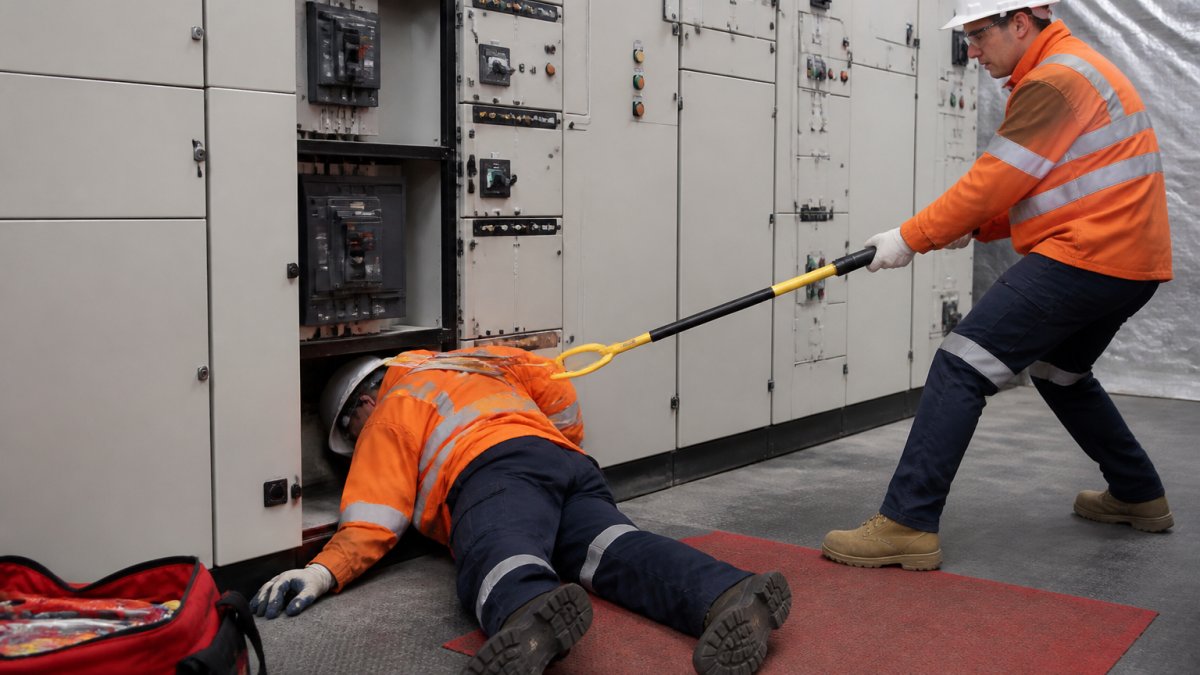
The safe rescue boundary is the point where you can act without becoming part of the circuit. That boundary is set by isolation and insulation, not by bravery.
Low Voltage Rescue Equipment You Must Have on Hand
Low voltage rescue equipment must be within reach of any live LV panel work area. In practice, that means a rescue kit mounted near the panel, checked and ready, not stored in a site shed three buildings away.
The composition of that kit is not a matter of preference. AS/NZS 4836, Safe working on low-voltage electrical installations, sets out the safe working practices that Australian electrical workplaces are expected to follow, and it treats rescue equipment and its accessibility as part of the isolation and emergency arrangements for live work.
A standard low voltage rescue kit typically includes:
- Rescue hook or insulated pole, long enough to reach a casualty without the rescuer entering the arc or contact zone, and rated for the voltage involved
- Insulated gloves, the correct class for the task, inspected before each use for cuts, cracks, ozone damage and contamination
- Safety signage, marking the panel, the isolation point and the location of the rescue kit so a rescuer can find it under pressure
- A first aid kit with resuscitation equipment, including a resuscitation mask or face shield, and an AED where the site’s risk assessment requires one
Inspection, testing and replacement
A kit that has never been checked is not a rescue kit; it is a box of assumptions. Most practitioners find a monthly visual inspection with a signed log is the minimum workable regime, with gloves and insulated tools tested or replaced according to the manufacturer’s instructions and the site’s procedures. Record the date, the inspector and any item removed from service.
Common equipment failures
The failures that show up again and again are mundane:
- Gloves stored in a hot vehicle or direct sunlight, degrading the rubber
- Rescue hooks cable-tied to a panel that has since been relocated
- Kits raided for general first aid and never restocked
- Signage faded or missing, so a rescuer cannot locate the isolation point
Photograph the kit and its location during your next toolbox talk, and attach the photo to the panel’s emergency information. Rescuers default to what they can remember under stress, and a visual cue beats a procedure document every time.
If you are unsure whether your current kit matches AS/NZS 4836 expectations for your panels, ask your provider or your electrical safety adviser to walk the site with you before the next live work job.
What the Course Covers: Skills, CPR and Assessment
A low voltage rescue course covers the skills to free a casualty from a live LV panel and deliver CPR until help arrives.
The core skills you learn:
- Rescue from live low-voltage electrical apparatus using safe procedures
- Cardiopulmonary resuscitation (CPR) on an adult casualty
- Managing an emergency scene, including isolation and calling for help
- Practical assessment of your rescue and CPR technique
The competency unit behind this training is UETDRMP018, which covers performing rescue from a live LV panel.
Assessment is hands-on. You will demonstrate a rescue and deliver CPR on a manikin while an assessor watches. There is no passing on theory alone.
Practise the rescue sequence out loud before your assessment. Naming each step as you go helps the assessor see your decision-making, and it builds the habit you will rely on in a real emergency.
Course Duration, Delivery Format and What to Bring
A combined low voltage rescue and CPR course typically runs as a one-day delivery, with the CPR component often taking a three-hour session and the full course around six hours.
Delivery is face-to-face. This is not a course you can complete online, because the practical skills and assessment require a real manikin, real equipment, and an assessor in the room.
What to bring and how to prepare:
- Photo ID for enrolment and certificate details
- Your USI (Unique Student Identifier) if you need a statement of attainment
- Comfortable clothing you can kneel and move in
- Closed-in shoes for the practical session
- A pen for any written components
Arrive early for booking and enrolment checks. Late arrivals can miss the safety briefing, which is part of the assessment.
Who Needs This Training and When to Refresh
Electrical workers, contractors, and anyone who works near or on live LV panels needs this training.
Refresher training is where many teams fall down. The competency has a recommended refresh cycle, and workplaces often set their own interval. Check your employer’s policy and the requirements for your licence renewal.
A low voltage rescue refresher course keeps your skills current and your competency valid.
Choosing a Low Voltage Rescue Refresher Course on the Gold Coast
Choosing a refresher course comes down to three things: whether the delivery satisfies the practical assessment requirements, whether the equipment and trainer are current, and how quickly you can get your team through without pulling them off site for a full day longer than necessary. For teams spread across multiple sites, a mobile trainer who comes to you removes the scheduling headache of sending everyone to a college.
What to compare, and why
The table below sets out the comparison criteria that matter most. It is deliberately generic, check each provider’s own current course page and confirm the details in writing before you book, because schedules, venues and inclusions change.
|
What to check |
Why it matters |
What to confirm with the provider |
|---|---|---|
|
Delivery format |
Practical assessment cannot be completed online |
Face-to-face, on-site or venue-based; ask how the practical component is assessed |
|
Competency units |
You need the units your employer or regulator specifies |
The exact unit codes on the statement of attainment, and whether CPR is included or separate |
|
Equipment provided |
You need a current rescue kit, manikin and AED trainer |
What is supplied, and whether you can use your own site equipment |
|
Group booking and mobilisation |
Larger teams need coordination |
Minimum and maximum group size, lead time, and whether training can be run at your site |
|
Certificate turnaround |
You may need proof for a client or audit quickly |
When the statement of attainment is issued, and in what format |
|
Trainer currency |
Real-world rescue knowledge counts |
Trainer qualifications and industry experience, not just the RTO’s registration |
|
Accessibility and support |
Not every learner fits the default format |
Physical participation requirements, language and literacy support, and reasonable adjustments |
|
Cost and inclusions |
Quotes are rarely like-for-like |
What the fee covers, equipment, materials, certificate, travel, and any re-assessment fee |
Gold Coast-specific questions to ask
Because availability on the Gold Coast varies by provider and by month, the useful comparison is not a static list of venues but a short set of questions you put to each provider:
- Where and when? Ask for the next three available dates and the venue address, not just the suburb.
- Is the training delivered at our site? If so, confirm the minimum group size and any travel charge.
- What is the cancellation and re-scheduling policy? Crew rosters change; you want to know the cost of moving a booking.
- What happens if a learner is not yet competent? Ask about re-assessment timing and fees before you book, not after.
- Can you provide a statement of attainment promptly? Confirm the issue timeframe and whether digital copies are available.
Refresher timing and recognition
Refresher training is where many teams fall down. The competency has a recommended refresh cycle, and workplaces often set their own interval.
Book your refresher before your certificate expires, not after. A lapsed competency can stop you from working on live panels and create a workplace safety gap, and a rushed booking is how teams end up on a course that does not match their site’s requirements.
Provide First Aid Gold Coast brings the training to your site, with all equipment provided and trainers who have extensive first aid and CPR experience. We are a training partner of Healthcorp (RTO ID 91222), so your statement of attainment is issued through a recognised registered training organisation.
Conclusion
Getting your team trained before an incident happens is the challenge worth solving now. A live LV panel rescue is a skill you hope never to use, but one you cannot improvise. Provide First Aid Gold Coast delivers mobile, hands-on low voltage rescue and CPR training at your site, with all equipment provided and a same-day certificate where possible. Call us to book your course.
Frequently Asked Questions
How do you perform a rescue from a live low-voltage panel?
Isolate the panel if you can do so safely, then call emergency services. Do not touch the casualty. Use a low voltage rescue kit, including a rescue hook and insulated gloves, to separate them from the electrical source. Check for response and breathing, start CPR if needed, and follow the DRSABCD action plan until help arrives. The live electrical rescue procedure must be practised under supervision before you rely on it in a real emergency.
How often should you complete a low voltage rescue refresher course?
Industry practice is to refresh every 12 months, though your employer’s risk assessment may require more frequent updates. A low voltage rescue refresher course keeps your rescue skills current and confirms your CPR competency, which also needs annual renewal. Many Gold Coast employers schedule refresher training on site so crews can complete it without losing a full day of work.
What low voltage rescue equipment is used during training?
Courses use a rescue hook or insulated pole, low voltage rescue gloves, a rescue kit bag, a CPR manikin and an automated external defibrillator trainer. You will also work with a simulated LV panel to practise isolation and the rescue sequence. All equipment is supplied on the day, so you only need to bring photo identification and wear comfortable clothing.
Can low voltage rescue training be delivered at our Gold Coast workplace?
Yes. Mobile trainers can deliver the course at your site, which suits construction, mining and manufacturing teams with shift rosters. On-site delivery means your crew trains on familiar equipment and you avoid travel time. Group sizes and scheduling are arranged around your operations, and pricing depends on participant numbers, dates and location, so request a quote for current rates.
Recent Comments