
Last Updated: October 25, 2026
Quick Summary
First aid training for construction sites starts by mapping your site’s risks, then booking the nationally recognised HLTAID011 Provide First Aid course for designated first aiders. You must ensure every shift has trained first aiders, stocked kits and a clear emergency response plan, since no single national ratio applies.
- HLTAID011 Provide First Aid is the nationally recognised qualification most construction sites need, and a CPR-only course does not cover your obligations.
- Never leave a shift without coverage, and nominate a backup for every designated first aider so one absence does not create a gap.
- Stock kits to your hazards, including burn gel, eye wash, splints and cervical collars, and check expiry dates monthly.
- Build a six-step incident response sequence and print it as a one-page card for every crib room, site office and vehicle.
- Run a drill each quarter and complete a first aid readiness audit quarterly, recording the results.
Table of Contents
- Step 1: Map Your Construction Site First Aid Requirements
- Step 2: Choose the Right Course, HLTAID011 Provide First Aid
- Step 3: Decide How Many Designated First Aiders You Need
- Step 4: Stock a Construction Site First Aid Kit That Matches the Hazards
- Step 5: Build a Construction Site Emergency Response Plan
- Step 6: Run Practical Scenarios and Competency Checks
- Step 7: Audit Readiness and Keep Records Current
- Frequently Asked Questions
- Book On-Site First Aid Training for Your Crew
Step 1: Map Your Construction Site First Aid Requirements
First aid training for construction sites starts with a hard look at your own site, not a course brochure. Many operations managers book a course first and work out the risks later. That order is backwards.
Under the model work health and safety laws, a person conducting a business or undertaking (PCBU) must provide first aid equipment, facilities and trained personnel.
At Provide First Aid Gold Coast, we see two failures again and again: sites with a certificate on the wall but no coverage on the afternoon shift, and sites with a full first aid kit still sealed in its packaging.
Work Health and Safety Duties for the PCBU
Your duty is to make sure workers get immediate treatment for injuries and illness. That means three things:
- Trained first aiders on every shift
- Kits stocked and accessible
- A clear plan for calling emergency services
The site manager usually carries the day-to-day responsibility. But the legal duty sits with the PCBU.
Risk Factors That Change Your Coverage
Not every construction site needs the same setup. Coverage should scale with:
- Worker numbers and how spread out they are
- Shift patterns, including night work and weekends
- Hazards present: height work, plant and machinery, electrical work, hazardous substances
A high-rise site in a dense area and a remote civil project carry very different risks. Treat them differently.
Step 2: Choose the Right Course, HLTAID011 Provide First Aid
HLTAID011 Provide First Aid is the nationally recognised qualification most construction sites need. It covers the skills a designated first aider uses on site, from casualty assessment through to handover to emergency services.
Watch out: don’t book a CPR-only course and assume it covers your obligations. HLTAID011 includes CPR, but the reverse is not true.
What the Qualification Covers On Site
The course blends theory with hands-on practice. Expect to cover:
- Casualty assessment and calling for help
- CPR on adults, children and infants
- Managing burns, bleeding and fractures
Delivery runs face to face, with some providers offering blended online theory plus a practical session. For construction crews, the practical component matters most. Your workers need to physically run a scenario, not click through slides.
Step 3: Decide How Many Designated First Aiders You Need
There is no single national ratio, and anyone who quotes you one is guessing. Your state or territory regulator sets the requirement, and it depends on workforce size, hazards and shift structure.
A practical approach:
|
Site Profile |
Suggested Approach |
|---|---|
|
Small crew, low-risk work, close to services |
At least one trained first aider per shift |
|
Medium site, mixed trades, multiple floors |
One first aider per work area or floor, plus a backup |
|
Large or high-risk site, remote location |
Trained first aiders across every shift, plus a dedicated first aid room |
The rule of thumb: never leave a shift without coverage. If your only trained first aider is on leave, you have a gap.
A planning checklist that scales with the site
Use this checklist each time the site changes, new phase, new trade, new shift pattern or new headcount, rather than setting coverage once and forgetting it.
- Count the maximum number of workers on site at any one time, not the average. Peak headcount is what your coverage must handle.
- Map the spread of work. Are crews in one area or scattered across floors, zones or a long linear site? Spread increases the number of first aiders needed.
- List every shift, including night, weekend and overtime. Each shift needs its own coverage; a day-shift first aider does not cover an afternoon crew.
- Identify high-risk activities, height work, plant and machinery, electrical work, hot works, hazardous substances, confined spaces, and add coverage where they occur.
Translate the duty into a simple coverage register
Keep a one-page register listing each shift, the designated first aider and backup, their certificate expiry dates, and the nearest first aid kit and AED. Update it whenever the roster changes. This gives you a defensible record that coverage matched the site’s risk profile at the time, which is what a regulator will look for after an incident.
Step 4: Stock a Construction Site First Aid Kit That Matches the Hazards
A construction site first aid kit is not a generic office box. It should match the injuries your site actually produces: cuts, crush injuries, eye damage, burns and fractures.
Stock to the hazards, not to a shopping list:
- Heavy-duty dressings and burn gel for welding and hot works
- Eye wash for dust, grit and chemical splash
- Splints and cervical collars for falls and crush events
- Heavy-duty gloves, shears and a torch
Check expiry dates monthly. A kit full of expired saline is worse than useless, because it gives false confidence.
Step 5: Build a Construction Site Emergency Response Plan
A construction site emergency response plan is a written procedure that tells every worker exactly what to do when someone is hurt.
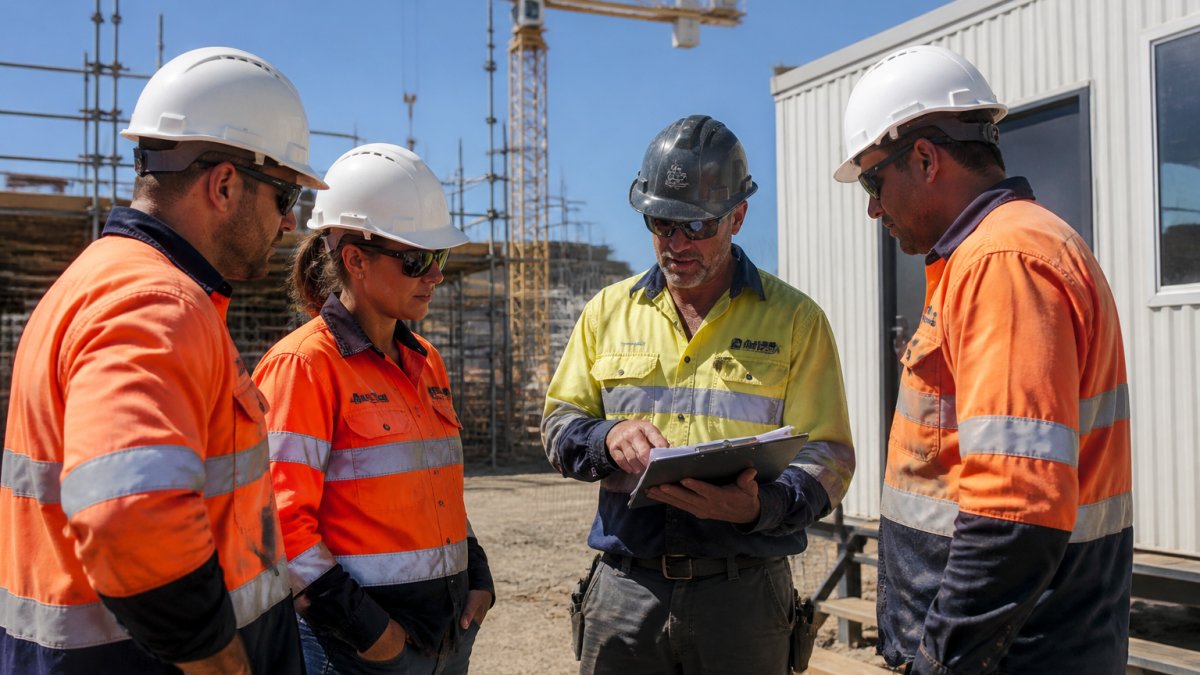
Most generic guides stop at “have a plan”. The useful version is a sequence every worker can follow under pressure. Build yours around these six steps and drill them until they are automatic.
Step-by-step incident response sequence
- Assess and make the area safe. The first person on scene checks for live services, moving plant, unstable structures or traffic before approaching. A second casualty helps no one. If the scene cannot be made safe, withdraw and call for help from a safe distance.
- Raise the alarm. Use the site’s agreed signal, radio channel, air horn, whistle or phone tree, so the designated first aider and site supervisor know immediately. Nominate a backup signal in case the primary method fails.
- Call emergency services (000). One nominated person calls, states the site address including the nearest cross street and gate number, describes the injury and hazards, and stays on the line until told to hang up. If mobile coverage is unreliable, the plan must name the satellite phone or radio location.
- Control site access. Send a worker to the gate to meet responders, open locked gates, clear vehicles from the access route and guide the ambulance to the casualty. On multi-storey or large sites, nominate a second person to escort responders from the gate to the patient.
- Provide first aid and monitor. The designated first aider manages the casualty until handover, recording observations, times and treatments given. Keep bystanders back and preserve the scene where possible.
- Hand over and record. Give paramedics a clear verbal handover, what happened, when, what was done, and any changes in condition, then complete the incident report and notify the PCBU.
Test the plan, don’t file it
Run a drill each quarter and note what went wrong, slow alarm, unclear address, blocked gate, no one at the gate. Fix the gap before the next drill. Record the drill date, scenario and actions taken so you can show continuous improvement to your regulator if asked.
Remote and high-risk sites need a different plan
Distance changes everything. For remote or high-risk construction sites, plan for:
- Longer ambulance response times, so more advanced first aid skills on site
- A satellite phone or radio where mobile coverage is patchy
- A trained first aider on every crew, not just one per site
- Clear evacuation routes for a stretcher
If help is an hour away, your first aiders are the emergency service. Build the plan around that reality, not around an assumption that an ambulance will arrive in minutes.
Step 6: Run Practical Scenarios and Competency Checks
Skills fade fast without practice. Book refresher scenarios every few months so your first aiders stay sharp.
Run scenarios that match your site:
- A fall from height with a suspected spinal injury
- A crush injury from plant or machinery
- A burns scenario from hot works
- An unresponsive worker in a confined space
Watch how each person performs. Do they check for danger first? Do they call for help early? Do they give clear handover to paramedics? Note gaps and retrain.
Step 7: Audit Readiness and Keep Records Current
A first aid readiness audit keeps you compliant and catches gaps before an incident does. Run one quarterly and record the results.
- Every shift has a current, trained first aider
- All certificates are in date, with renewal dates tracked
- Kits are stocked, accessible and in date
- The emergency response plan is current and posted on site
Keep a simple register of certificate expiry dates. Chasing renewals manually is how gaps appear.
Frequently Asked Questions
How many trained first aiders should a construction site have?
There is no single national number. The model Code of Practice for First Aid in the Workplace asks the PCBU to work it out from worker numbers, shift patterns, site layout, and how long emergency services will take to reach the site. A practical approach is at least one designated first aider per work area or crew, plus cover for every shift and for leave. High-risk or remote sites need more, because help is further away and the range of likely injuries is wider.
How often should construction workers renew their first aid training?
HLTAID011 Provide First Aid is current for three years, but the CPR component must be renewed every 12 months. Many construction sites tighten this further by requiring current CPR for every designated first aider, so plan refreshers annually rather than waiting for the certificate to lapse. Track expiry dates per worker, not per team, because a lapsed CPR unit can leave a site without compliant coverage.
Can construction workers complete first aid training on site?
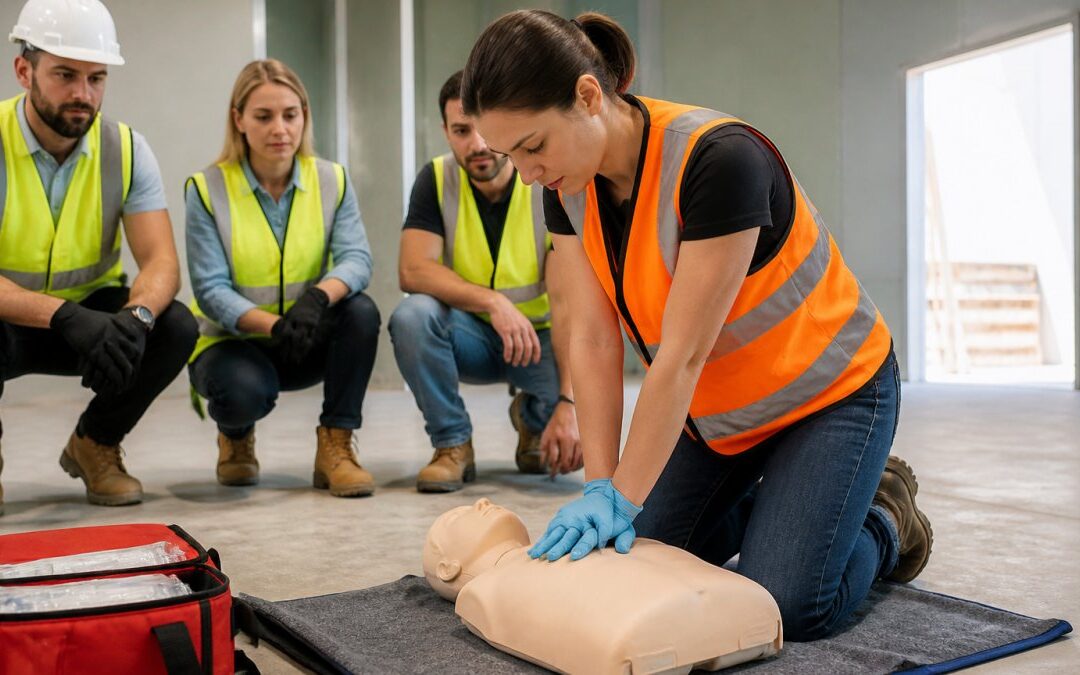
Yes. Mobile training providers bring equipment and trainers to your location, which suits construction crews because it removes travel time and lets training run around site hours. On-site delivery also lets the trainer build scenarios around your actual hazards, such as falls from height, electrical incidents, and manual handling injuries. Confirm the provider is a registered training organisation and check that the site has a suitable indoor space for the practical components.
What type of first aid kit does a construction site need?
Match the kit to the hazards and the number of workers, not to a generic shopping list. Construction sites typically need heavy-duty kits with burns dressings, eye irrigation, large wound dressings, and trauma supplies for crush and fall injuries, plus a portable kit for each work area and vehicle. Check contents monthly, restock after every use, and keep kits in known, accessible locations that every worker can reach quickly.
Book On-Site First Aid Training for Your Crew
Getting every worker trained and every certificate current is the hard part. We make it simpler by bringing the training to your site, with all equipment supplied and trainers who have run real emergencies.
Provide First Aid Gold Coast is a training partner of Healthcorp (RTO ID 91222), and we deliver practical, hands-on courses your crew will actually remember. Call us to book your course and get your site compliant.

Recent Comments