
Last Updated: October 23, 2026
Quick Summary
Keep first aid training engaging by making learners do the work rather than watch it: run hands-on practice stations, realistic scenarios with structured debriefs, and short spaced refreshers like 20-minute toolbox talks. Rotate roles so every pair of hands stays busy, and measure skill retention with a follow-up check weeks later.
- Set up four or five timed practice stations covering CPR, bleeding control, the recovery position, defibrillation and calling for help.
- Run a 45-minute scenario block for groups of eight to twelve, rotating roles so nobody stays observer.
- Debrief each scenario with three questions: what went well, what was missed, what to change.
- Run 20-minute toolbox talks on one skill at a time and space them across the year.
- Check recall and skill four to six weeks later to see what actually stuck.
Table of Contents
- Why Engagement Decides Whether First Aid Training Sticks
- Interactive First Aid Training Activities That Get Everyone Involved
- Building First Aid Training Scenarios That Feel Real
- Workplace First Aid Refresher Training People Actually Turn Up For
- Making On-Site First Aid Training Work for Your Team
- Adapting Activities for Different Learners and Experience Levels
- Measuring Whether the Training Actually Worked
- Frequently Asked Questions
Why Engagement Decides Whether First Aid Training Sticks
Most first aid certificates expire with the skills still unused.
At Provide First Aid Gold Coast, we run mobile sessions on site, and we see the difference hands-on practice makes in how much people retain. Engagement is not entertainment.
Here is the core argument of this guide: first aid training sticks when learners do the work, not when they watch it. Everything below serves that one idea.
Interactive First Aid Training Activities That Get Everyone Involved
Interactive first aid training activities work because adults learn skills by doing, not listening. The trick is keeping every pair of hands busy at once, so nobody drifts to their phone.
Try these formats:
- Pair-and-swap bandaging: one person wraps, the other checks the dressing, then swap.
- Recovery position relays: small teams race to roll a partner safely, then review each attempt.
- Pressure drills: practise stopping simulated bleeding with direct pressure and a dressing.
- AED scavenger hunt: find the nearest defibrillator and talk through access.
Practice Stations That Keep Hands Busy
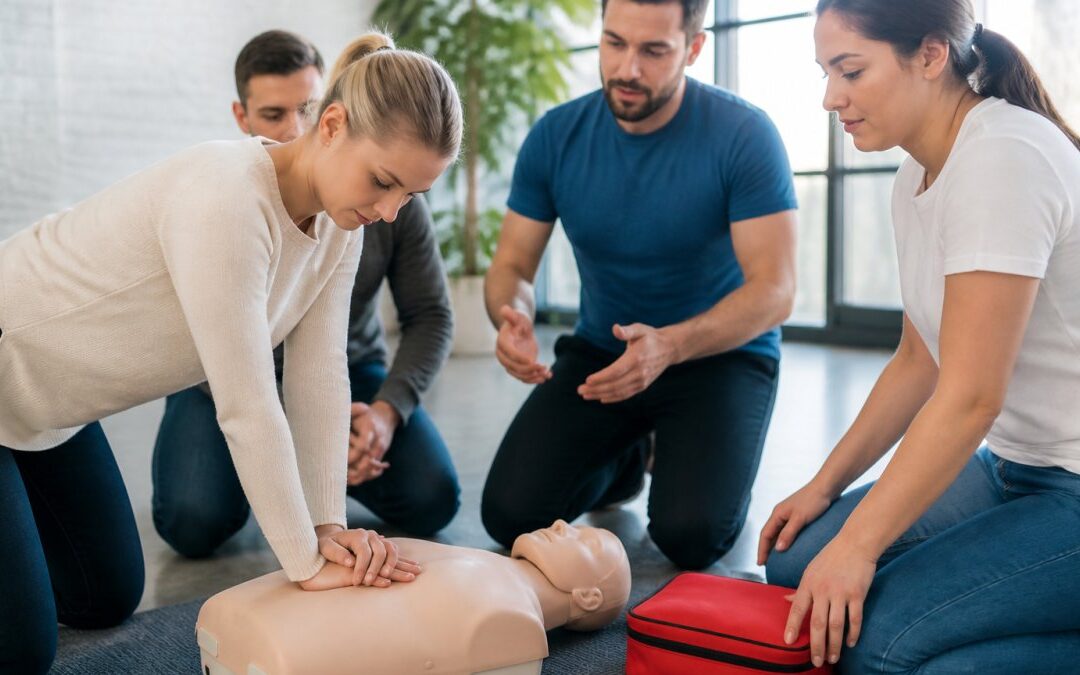
Set up four or five practice stations and rotate small groups through them on a timer. Each station covers one skill: CPR, bleeding control, the recovery position, defibrillation, and calling for help.
Rotation keeps energy up and stops one confident person dominating. Give each station a simple instruction card and a clear outcome. The Australian Resuscitation Council guidelines are a solid reference for current CPR and defibrillation practice.
Building First Aid Training Scenarios That Feel Real
Realistic first aid training scenarios turn theory into judgement. A scenario is a short, acted-out emergency that forces learners to assess danger, call for help, and act under mild pressure.
Keep scenarios simple and safe. Brief the “casualty” actor, set a time limit, and watch for learners freezing. That freeze is useful information, not failure.
A Ready-to-Run Scenario Session Plan
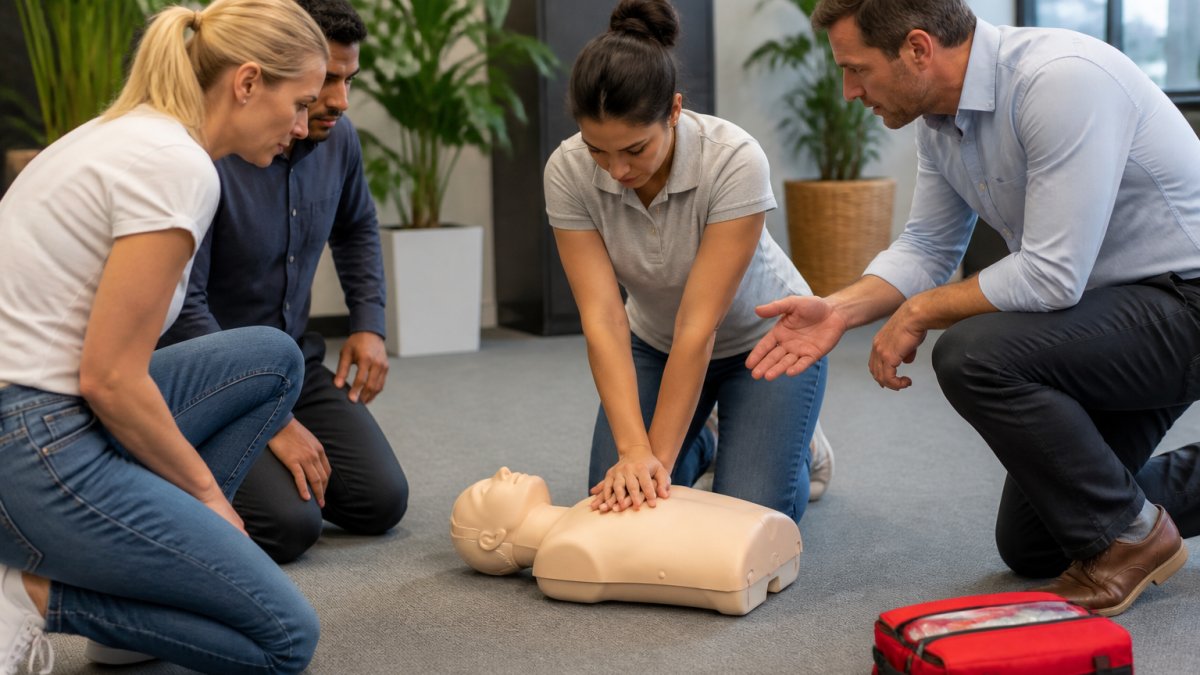
Most trainers improvise scenarios and lose half the session to setup. A fixed agenda keeps the pace up and gives every learner repeated hands-on turns. Here is a 45-minute block that works for groups of eight to twelve:
|
Time |
Activity |
Purpose |
|---|---|---|
|
0-5 min |
Safety and content briefing |
Warn about distressing content, confirm exits and opt-out |
|
5-10 min |
DRSABCD recall from memory |
Retrieval practice before instruction |
|
10-20 min |
Scenario round one (pairs) |
One casualty, one responder, one observer |
|
20-25 min |
Structured debrief |
What went well, what was missed, what to change |
|
25-35 min |
Scenario round two (rotated roles) |
Same skill, harder variables |
|
35-42 min |
Scenario round three (small teams) |
Multiple casualties or an uncooperative casualty |
|
42-45 min |
Close and one takeaway each |
Consolidation and confidence check |
Rotate roles so nobody spends the whole block as the observer. The observer role is valuable, but it should be a turn, not a hiding place.
Good scenario prompts, graded by difficulty, include:
- Entry level: a colleague collapses near a live electrical panel; a child chokes at a staff lunch.
- Intermediate: a player goes down with a suspected fracture; a visitor faints in a corridor with no phone signal.
- Advanced: two casualties at once; a casualty who refuses help; a bystander who panics and gives wrong instructions.
Designing Scenarios That Are Safe for Everyone
Psychological safety is not a soft add-on. Some learners carry real trauma around emergencies, and a sprung graphic scenario can shut a person down for the rest of the course.
A simple mechanism is a content card at the start of the session: green means comfortable with all scenarios, amber means warn me first, red means observer only. Honour the card without comment. Learners who opt out of acting can still debrief, and many rejoin once they see the group is safe.
Debriefing Without Making Anyone Feel Silly
Debriefing is where the learning locks in. Run it as a group review, not a critique of one person. Ask three questions: What went well? What was missed?
Praise the action, correct the process. “You called for help fast, and next time check the airway before moving them” lands better than a lecture.
A structured debrief beats a general chat. Try a plus-delta format: each learner names one thing that worked and one thing to change, then the instructor adds a single correction.
Workplace First Aid Refresher Training People Actually Turn Up For
Workplace first aid refresher training fails when it feels like a repeat of the full course. Short, sharp sessions beat long ones for attendance and retention.
Run 20-minute toolbox talks on one skill at a time. Use retrieval practice: ask people to recall the DRSABCD steps from memory before you show the answers. Spacing these short refreshers across the year keeps skills warm between formal renewals.
Under the model WHS laws, Safe Work Australia’s first aid in the workplace code sets out what duty holders must provide.
|
Refresher format |
Length |
Best for |
|---|---|---|
|
Toolbox talk |
15-20 min |
One skill, whole team |
|
Scenario drill |
30 min |
Practising judgement |
|
Full refresher |
Half day |
Recertification |
Low-Cost and Remote-Friendly Refreshers
Not every team has a training room, a manikin for each pair, or a budget for a facilitator every month. Engagement does not require equipment. A few options that cost little and travel well:
- Verbal walk-throughs: pairs talk each other through DRSABCD and the recovery position, correcting as they go.
- Cushion compressions: a firm cushion or rolled towel gives a reasonable sense of hand position and rhythm when a manikin is not available.
- Phone-based quizzes: a short recall quiz sent by message before a toolbox talk primes the group and gives you a baseline.
- Hybrid sessions: run the practical block on site and the knowledge refresher online, so remote or shift-based staff still take part.
- Recorded micro-briefings: a two-minute video on one skill, followed by a live Q&A, suits teams spread across sites.
None of these replace hands-on practice for certification, but they keep skills warm between formal courses and they remove the excuse that refreshers are too hard to schedule.
Adapting Refreshers for Mixed Experience and Needs
A refresher group often mixes a first-timer, a long-serving first aider, and someone with mobility limits or English as an additional language. One session cannot serve all three at the same depth, so build in choice.
Pair a nervous first-timer with a calm colleague. Give experienced learners the messy scenarios, like multiple casualties or a casualty who refuses help. For anyone with mobility limits, offer seated practice and verbal walk-throughs so they still take part.
Measuring Whether the Refresher Actually Worked
Attendance is not engagement, and enjoyment is not learning. Measure refreshers with three quick checks:
- Recall: a five-question quiz on DRSABCD and the location of the nearest AED and first aid kit, given before and after.
- Skill: a short practical check, can they perform compressions and control simulated bleeding unaided?
- Confidence: a self-rating from one to five before and after, tracked across the year.
A follow-up check four to six weeks later tells you what stuck. If recall drops sharply, shorten the gap between refreshers or change the format. A team that enjoyed the session but cannot find the defibrillator has not learned much.
Making On-Site First Aid Training Work for Your Team
On-site first aid training removes the biggest barrier to engagement: the commute. When training happens in the actual workplace, learners practise in the space where a real emergency would occur.
That context matters. Staff can point to the real first aid kit, the real defibrillator, and the real exits. Our mobile service brings all equipment to your location, so the setup fits around your shifts rather than the other way round.
To make an on-site session land:
- Book a room with floor space for practice stations.
- Split large teams into rotating groups.
- Confirm the nearest AED and first aid kit locations beforehand.
- Keep group sizes small enough for hands-on time.
Adapting Activities for Different Learners and Experience Levels
No two learners arrive with the same confidence. Adapt activities so beginners get repetition and experienced staff get harder judgement calls.
Pair a nervous first-timer with a calm colleague. Give experienced learners the messy scenarios, like multiple casualties or a casualty who refuses help.
Psychological safety matters here. Some people carry real trauma around emergencies. Warn the group before a scenario, allow anyone to step out, and never spring a graphic scenario without notice.
Measuring Whether the Training Actually Worked
Engagement only counts if it improves skill. Measure it with a short practical assessment at the end, then a follow-up check weeks later.
Track three things:
- Skill retention: can they perform CPR and bleeding control unaided?
- Confidence: a quick self-rating before and after.
- Recall: a short quiz on DRSABCD and emergency procedures.
Skill assessment beats a smile sheet. A team that enjoyed the day but cannot place a defibrillator pad has not learned much.
Frequently Asked Questions
How can you make first aid training more engaging?
Cut the lecture time and add hands-on practice. Run short practice stations for CPR, bleeding control and the DRSABCD action plan, then rotate people through realistic first aid training scenarios drawn from your own workplace. Keep sessions moving with short refreshers and toolbox talks rather than one long annual session. Feedback straight after each attempt helps people correct mistakes while it is fresh, and it keeps learner confidence climbing instead of stalling.
What activities can make a first aid course more interactive?
Try scenario-based learning with a partner acting as the casualty, timed DRSABCD drills, and practice stations for defibrillation and bandaging. Small group role plays work well because everyone has a job: one person assesses, one calls for help, one manages the airway. Short quizzes and retrieval practice at the start of each session also lift knowledge retention without eating into practical skills time.
How do you keep participants engaged during first aid refresher training?
Run refreshers in short blocks of 30 to 60 minutes rather than a full day, and change the scenario each time so people are not repeating the same drill. Use toolbox talks and team talks for quick CPR or bleeding control practice, then finish with a scenario review. Rotating who leads each drill builds learner confidence and spreads practical skills across the whole team.
How can workplace first aid training reflect real emergencies?
Base scenarios on your own risk assessment: a fall from height on a construction site, a choking incident in a childcare room, or a cardiac arrest in a warehouse. Include the actual first aid kit and AED locations so people practise finding them under pressure. Add complications like a noisy environment or a blocked exit, and debrief afterwards on what worked and what slowed the response down.
Keeping first aid skills sharp is a scheduling problem as much as a teaching one. Provide First Aid Gold Coast brings practical, hands-on training to your site, with all equipment supplied and trainers who make the session genuinely engaging. As a training partner of Healthcorp, we focus on real-world scenarios your team will remember when it counts. Call us to book your course and get your team confident before the next refresher falls due.

Recent Comments