
Last Updated: October 30, 2026
Quick Summary
The cost of mobile first aid training versus a centre is not a straight comparison, because a centre fee excludes travel, staff downtime and venue costs. Mobile training carries a largely fixed cost spread across your group, so per-person cost falls as headcount rises. Break-even is the group size where your itemised mobile quote equals the centre fee plus travel and staff time.
- Mobile training carries a largely fixed cost, so per-person cost falls as headcount rises.
- Centre-based training carries a per-head cost that rises in a straight line with headcount.
- Ask every provider for the itemised quote, the minimum group charge, and whether travel and after-hours surcharges are included.
- A second trainer is needed once the group exceeds what one trainer can safely supervise through practical assessment.
- Provide First Aid Gold Coast is a training partner of Healthcorp, RTO ID 91222.
Table of Contents
- Why the Cost of Mobile First Aid Training vs Centre Training Is Not a Straight Comparison
- The Full On-Site First Aid Training Cost Breakdown
- Training Centre Costs: The Line Items People Forget
- First Aid Training Travel Fees and What Triggers Them
- Group First Aid Training: Where the Break-Even Point Sits
- First Aid Course Duration and How It Affects Total Cost
- Accreditation and Quality: Same Certificate, Different Delivery
- Request a Quote for Your Team’s First Aid Training
- Frequently Asked Questions
Why the Cost of Mobile First Aid Training vs Centre Training Is Not a Straight Comparison
The cost of mobile first aid training vs centre-based delivery rarely comes down to a single course fee.
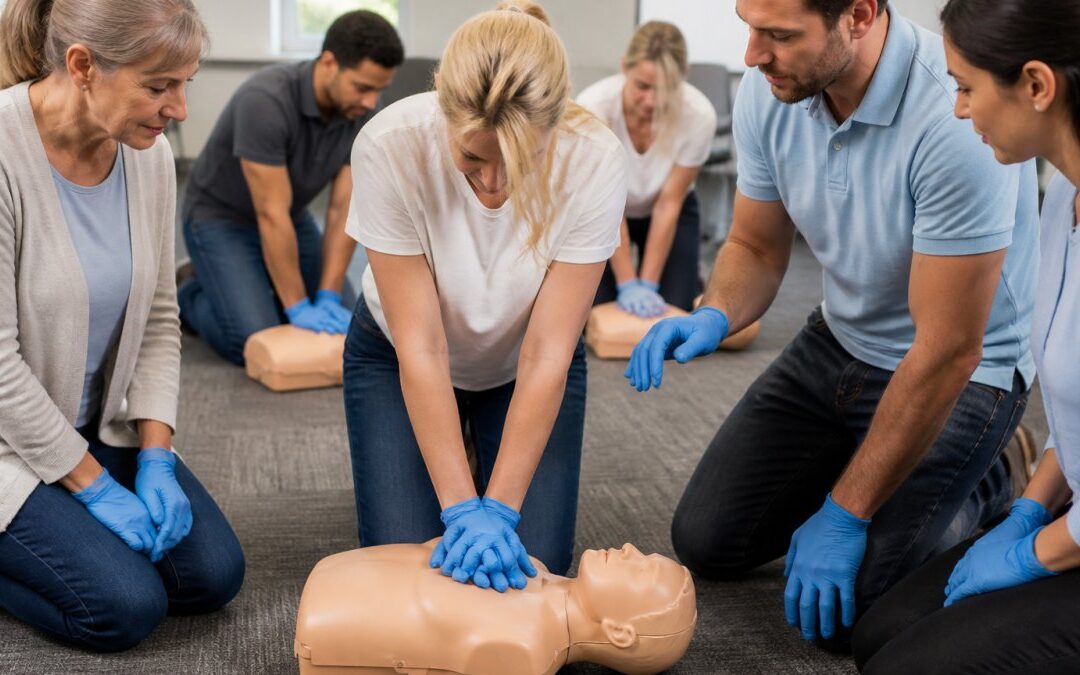
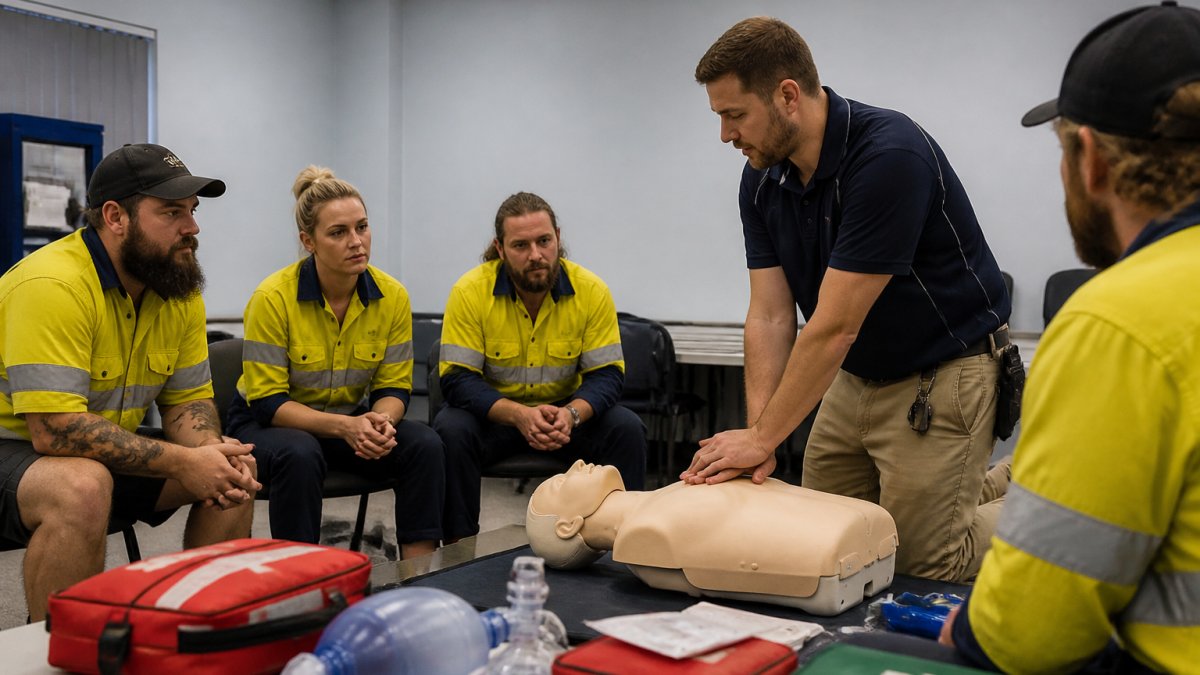
Mobile first aid training is first aid instruction delivered at your own workplace, sporting ground or site by a trainer who brings the training equipment to you. The certificate is the same. The delivery model is not.
Below, we break down both cost structures, show where the break-even point sits for a group, and explain which costs most quotes leave out, so you can build a like-for-like comparison for a budget conversation.
The Full On-Site First Aid Training Cost Breakdown
An on-site quote usually bundles several components into one rate. Understanding what sits inside that rate is the first step to comparing it fairly against a training centre. Ask for each line separately so you can see what is fixed, what scales with the group, and what is a genuine extra.
The Line Items Behind a Mobile Quote
- Trainer time. A session fee or hourly rate with a minimum call-out; half-day and full-day sessions are priced differently because the trainer’s day is committed either way.
- Minimum group charge. Some providers set a minimum group charge, so a small group can cost the same in total as a larger one. This can drive per-person cost up at small group sizes.
- Equipment and consumables. All training equipment is provided, confirm with us what is included in your quote.
- Travel. Distance from the trainer’s base, travel time, tolls and parking, often quoted separately or built into a zone-based rate.
- Venue requirements. A mobile session still needs floor space for manikins, room for scenarios and equipment access. If your site cannot supply that, a portable setup or off-site room may be a surcharge.
- Certificate issuance. Ask whether re-issuance or replacement cards carry a fee.
- Surcharges. After-hours, weekend, public holiday, multi-site routing and short-notice booking changes.
A Worked Example Structure (Use Your Own Figures)
Because prices change and vary by provider, build the quote from your own inputs rather than a published rate. A transparent quote lets you populate a table like this:
|
Line item |
Mobile (on-site) |
Centre-based |
|---|---|---|
|
Course fee per person |
Quoted per person or per group |
Published per-person fee |
|
Minimum group charge |
Applies if group is small |
Not applicable |
|
Trainer travel |
Quoted or zone-based |
Staff travel to venue |
|
Equipment and consumables |
Usually included |
Included in course fee |
|
Venue |
Your own room |
Usually included |
|
Staff time away from work |
Minimal commute |
Travel time plus course time |
|
Certificate issuance |
Usually included |
Usually included |
Fill the mobile column from the itemised quote and the centre column from the published fee plus your own travel and wage estimates. The comparison only becomes real once both columns use the same course, duration and practical assessment.
Indirect Costs: Staff Time and Operational Disruption
A hidden cost of centre-based training is staff time. If employees travel to a centre, you pay for their hours plus travel time and lose coverage on site. Mobile training removes much of the commute, as staff train at or near the workplace.
For a construction or mining crew, pulling people off site for a half day plus travel can cost more in lost productivity than the course fee itself. Estimate it as hours away from the job multiplied by each employee’s loaded hourly cost, then add backfilling or rescheduling costs.
What Most Quotes Leave Out
When comparing quotes, check three things: whether a minimum group charge applies, how travel is charged, and at what group size an additional trainer would be needed. Ask where that threshold sits before assuming per-person cost keeps falling.
None of this makes mobile training expensive by default. It makes the invoice predictable, which is what a budget conversation needs.
Training Centre Costs: The Line Items People Forget
A training centre fee looks simple, but several costs sit outside it: parking, travel to and from the venue, and time away from the workplace.
There is a scheduling cost too. Centre courses run to a fixed timetable, so you fit your roster around their calendar.
None of this makes training centres a poor choice. For an individual booking a single course, a centre is often the simplest option. The comparison only shifts when you are moving a group.
First Aid Training Travel Fees and What Triggers Them
Travel costs can vary with distance and timing, and they are worth confirming early. Ask directly whether a quote includes travel, and whether a single visit can cover several locations in one day. Get the travel line in writing before comparing totals.
Group First Aid Training: Where the Break-Even Point Sits
Group first aid training changes the economics. The break-even point is the group size at which the total cost of bringing a trainer on-site equals the total cost of sending the same group to a centre, once travel and staff time are included.
The Mechanism: Fixed Cost Versus Per-Head Cost
Mobile training carries a largely fixed cost: the trainer’s session fee, the minimum group charge, travel and equipment.
Centre-based training carries a largely per-head cost: the published course fee multiplied by the number of learners, plus travel and staff time for each person. That cost rises in a straight line with headcount.
Break-even is where the falling mobile line crosses the rising centre line. Below that group size, the centre is cheaper in total; above it, mobile is.
A Worked Structure for Your Own Numbers
Use the same four inputs for both options and calculate total cost, not per-person cost, first:
- Mobile total = session fee (or minimum group charge, whichever is higher) + travel + any surcharges + staff time away from work (minimal commute).
- Centre total = course fee per person × number of learners + staff travel cost per person × number of learners + staff time away from work (course time plus commute) × number of learners.
- Per-person cost = total ÷ number of learners for each option.
- Break-even group size = the headcount where the two totals are equal. Solve for it by testing a few group sizes rather than by formula, because the minimum group charge and second-trainer trigger make the mobile line a step function rather than a smooth curve.
How the Answer Shifts With Group Size
The pattern most practitioners find is consistent even though the dollar figures vary:
- Very small groups (roughly under the minimum group charge). The mobile total is dominated by the fixed minimum, so per-person cost is high and the centre usually wins on total cost unless travel and downtime are severe.
- Mid-sized groups. The fixed mobile cost is spread across more people while the centre cost rises per head. This is where the lines cross, and where the answer is most sensitive to distance and wage rates.
- Large groups. Mobile is usually clearly cheaper per person, but watch the second-trainer trigger: once the group exceeds what one trainer can safely supervise through practical assessment, the fixed cost steps up and the per-person advantage narrows.
- Multi-site teams. If staff are spread across locations, the centre option multiplies travel and downtime per site, while a single mobile visit can sometimes cover several sites in a routed day. That can move the break-even point sharply in mobile’s favour.
Indirect Costs Move the Line
The break-even calculation above includes staff time, but it is worth isolating because buyers most often underestimate it. Time away from work is course time plus commute for the centre option, and course time only for mobile.
Run the numbers with your own figures rather than a rule of thumb. A group of six and a group of twenty will land in different places, and the only comparison that survives a budget conversation uses the same course, duration and assumptions on both sides.
First Aid Course Duration and How It Affects Total Cost
Course duration drives total cost because it determines how much staff time you spend.
Mobile delivery can compress the day because there is no commute at either end. Staff arrive at the on-site training room, complete the hands-on skills and practical assessment, and return to work.
When comparing quotes, check that both options cover the same course and practical assessment. A shorter, cheaper course that skips hands-on skills is not a like-for-like comparison.
Accreditation and Quality: Same Certificate, Different Delivery
Accreditation should not change with the delivery mode. A nationally recognised certificate comes from a registered training organisation, whether the course runs at a centre or on your site.
Provide First Aid Gold Coast is a training partner of Healthcorp, RTO ID 91222. Our trainers bring all equipment and run practical, real-world scenarios so your team leaves ready to act.
Quality comes down to the trainer and the assessment, not the postcode. A hands-on session with realistic scenarios builds more confidence than a lecture, wherever it is held.
Request a Quote for Your Team’s First Aid Training
The right delivery mode depends on your group size, your sites and how much staff time you can spare. Rather than guess, get both numbers in front of you and compare them on the same basis.
Provide First Aid Gold Coast brings practical first aid and CPR training to your workplace, with all equipment provided and trainers who run realistic scenarios.
Call us to book your course and get a quote tailored to your team.
Frequently Asked Questions
Is mobile first aid training more expensive than training at a centre?
Once you add staff travel time, lost productivity and parking or transport costs, the total cost of each option can differ from the course fee alone. Ask for a quote based on your headcount and location to see where you sit. Pricing depends on quantity, dates and delivery, so please visit our website for current prices or a quote.
How many people do you need for on-site first aid training to be cost-effective?
There is no fixed number. Share your headcount and site details when requesting a quote so the total cost of each option can be compared for your situation.
Are travel fees charged for mobile first aid training?
Travel costs can vary with distance and timing. Ask directly whether travel fees apply to your site and whether multiple sites in one booking attract extra charges.
How long does a first aid course take, and does duration affect the price?
First aid course duration affects cost because staff time off the job is a real cost. Confirm the expected duration when comparing quotes so you are comparing like for like.
Comparing delivery modes is really a question of total cost, not headline fee. If your team is large enough that travel and downtime add up, on-site training usually wins on both cost and convenience. Provide First Aid Gold Coast delivers mobile training across your sites, supplies every piece of equipment, and runs practical scenarios that leave staff confident. Call us to book your course and get a clear quote for your group.

Recent Comments