
Table of Contents
- Why On-Site First Aid Training Beats Sending Staff Away
- The Core Benefits of Workplace First Aid Training
- Tailoring Group First Aid Training to Your Actual Hazards
- Building Workplace Emergency Preparedness Beyond the Certificate
- First Aid Refresher Training: Why Skills Fade Without Practice
- Measuring Whether Your On-Site First Aid Training Actually Worked
- Conclusion: Booking On-Site Training That Fits Your Team
- Frequently Asked Questions
Last Updated: October 9, 2026
Why On-Site First Aid Training Beats Sending Staff Away
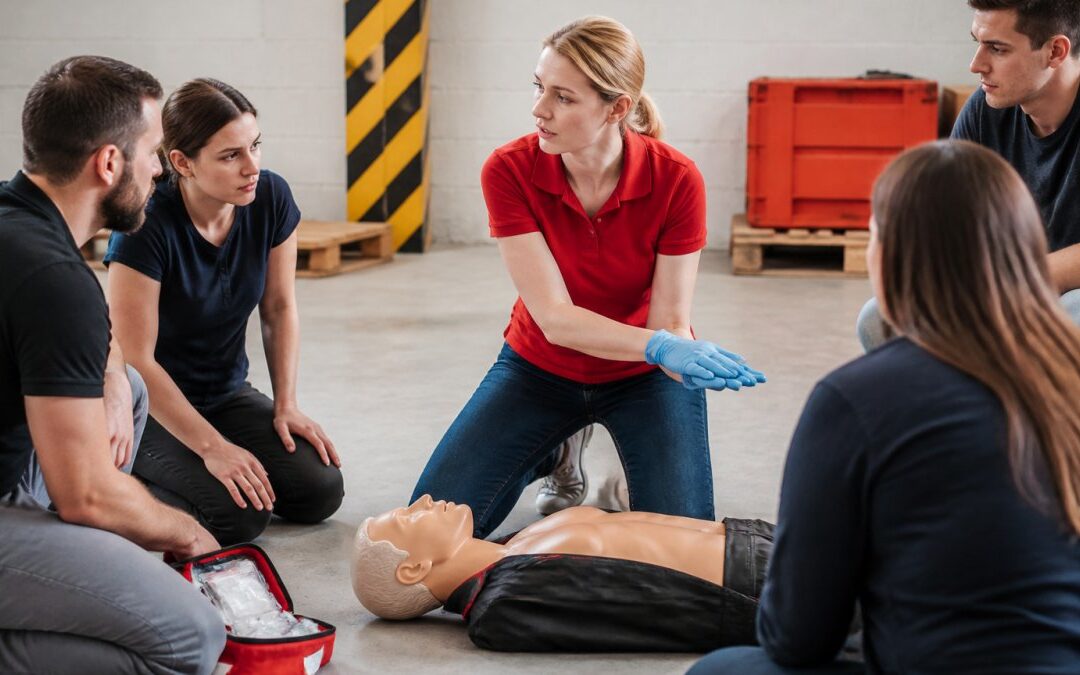
On-site first aid training is a course delivered at your own workplace, using your own rooms and your own equipment, rather than at an external training centre.
That distinction matters more than most employers realise. At Provide First Aid Gold Coast, we deliver workplace first aid training at construction sites, childcare centres, depots, club rooms and offices, and the pattern is always the same: when training happens on familiar ground, staff ask better questions and practise with more confidence.
Sending eight staff to an off-site course means eight people off the tools, plus travel time, parking and lost production.
Below, we break down the core benefits of on-site first aid training, how to tailor group first aid training to your real risks, and how to measure whether it worked.
What Changes When Training Comes to You
The delivery model changes three things at once: travel time, group cohesion and scenario realism.
When your team trains together on site, everyone hears the same instructions and practises the same drills. A supervisor learns what the first aider beside them can do. A new starter sees how the crew responds.
Travel time is the quieter win. A course across town can absorb half a day in transit alone for a team of ten.
The Core Benefits of Workplace First Aid Training
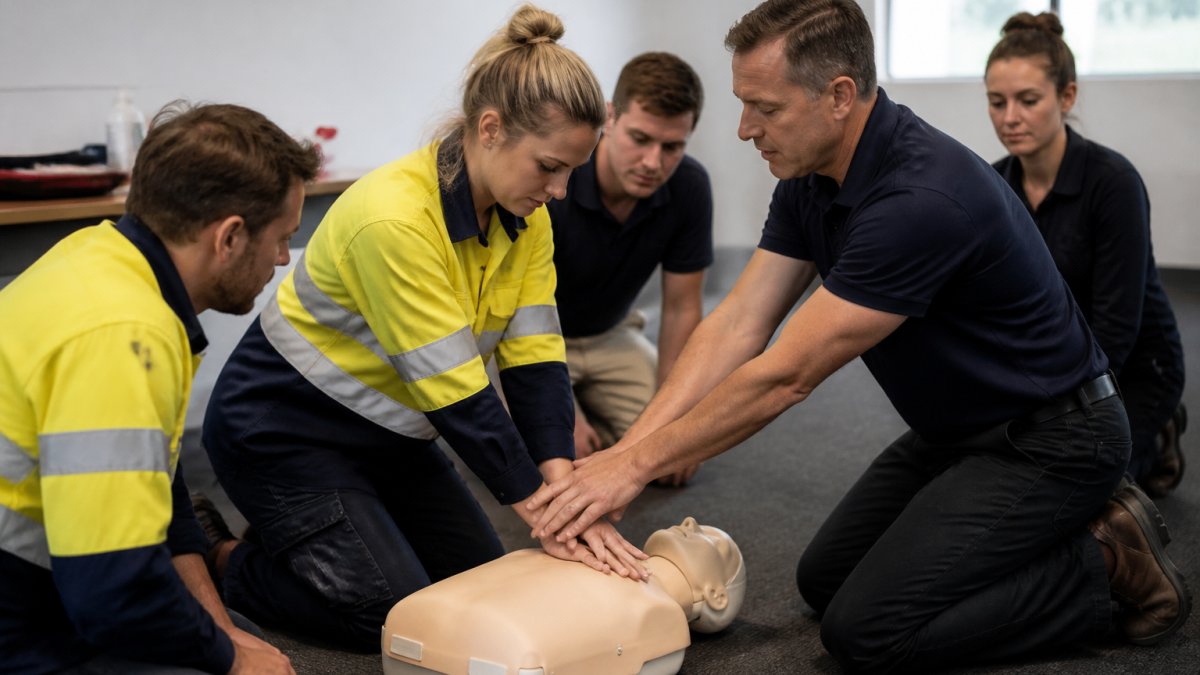
Workplace first aid training delivers its value in the first few minutes of an incident, before an ambulance arrives. Trained staff can assess a casualty, call for help correctly and begin care immediately.
Here are the benefits that matter most to employers:
- Faster emergency response. Staff recognise what they are seeing and act instead of freezing.
- Injury stabilisation. Correct care in the first minutes can prevent a minor injury becoming a serious one.
- Prevention of further harm. Trained staff know what not to do, which matters as much as what to do.
- Confidence to act. Employees who have practised a skill are far more likely to use it under pressure.
- Stronger safety culture. Teams that train together talk about hazards more openly.
- Compliance with your duties. Work health and safety law requires employers to provide adequate first aid arrangements, and trained first aiders are central to that.
The Quantified Case: On-Site Versus Off-Site Delivery
Most articles stop at “on-site is more convenient”. The real difference shows up when you count the hours. Consider a team of ten staff booked into a full-day first aid course.
|
Cost factor |
Off-site course |
On-site course |
|---|---|---|
|
Travel time per person |
30-60 minutes each way |
Nil |
|
Total travel hours (team of 10) |
10-20 hours |
0 hours |
|
Parking or public transport costs |
Often payable per person |
Nil |
|
Course fee |
Per person |
Usually a flat group rate |
|
Supervision back on site |
Roster gaps while staff are away |
Trainer comes to you |
|
Scenario realism |
Generic training room |
Your own workshop, yard or office |
For a ten-person team, the travel alone can absorb a full working day of combined labour before anyone has touched a manikin. That is the number worth putting in front of a manager who is comparing quotes.
Faster Emergency Response and Injury Stabilisation
Speed is the whole game in a medical emergency. A trained first aider can begin basic life support while someone else calls triple zero (000), rather than losing minutes working out who is in charge.
The skills that matter most in a workplace setting are unglamorous but decisive: checking for danger, assessing response and breathing, starting CPR, using an automated external defibrillator, controlling bleeding, and placing a casualty in the recovery position.
Risk-Based Depth: Why the Same Certificate Can Look Different on Site
Two workplaces can hold the same certificate and be prepared for very different emergencies. The benefit of on-site delivery is that the trainer can weight the day towards the hazards your team actually faces:
- Construction and trades: crush injuries, falls from height, electrical contact, serious bleeding, heat stress.
- Childcare and education: choking, anaphylaxis, asthma, febrile convulsions, head injuries.
- Sporting clubs: on-field assessment, concussion protocols, sprains, heat illness, suspected spinal injury.
- Office and retail: cardiac events, fainting, minor wounds, burns, slips and trips.
A generic off-site course cannot walk your yard, see your confined spaces or notice that your nearest defibrillator is three rooms away from where the forklifts operate. On-site training can.
Tailoring Group First Aid Training to Your Actual Hazards
Generic courses cover generic risks. Group first aid training works best when the content is matched to your workplace hazards, your team size and your site layout.
A construction workplace needs heavy emphasis on crush injuries, falls, electrical contact and serious bleeding. A childcare centre needs choking, anaphylaxis, asthma and febrile convulsions.
Team size shapes the format too. Small groups get more hands-on repetition per person.
|
Hazard profile |
Priority skills to cover |
Typical team focus |
|---|---|---|
|
Construction and trades |
Bleeding control, crush injury, falls, electrical contact |
Site crews and supervisors |
|
Childcare and education |
Choking, anaphylaxis, asthma, febrile convulsions |
All room staff and relief educators |
|
Sporting clubs |
On-field assessment, concussion, sprains, heat illness |
Coaches, volunteers, trainers |
|
Office and retail |
Cardiac events, fainting, minor wounds, burns |
First aid officers and wardens |
Building Workplace Emergency Preparedness Beyond the Certificate
A certificate is the starting point, not the finish line. Workplace emergency preparedness depends on equipment, clear procedures and people who know where both are.
Check that your first aid equipment and facilities match your risk profile and your workforce. Kit locations should be signed, stocked and known to every shift.
Inclusive delivery matters here. Staff with language barriers, hearing loss, or limited physical strength need to know which role they play in a response.
First Aid Refresher Training: Why Skills Fade Without Practice
First aid refresher training keeps skills usable. CPR compression depth, hand placement and bleeding control techniques all degrade without practice, and the gap between courses is where confidence quietly disappears.
Most workplaces treat refresher training as a renewal task. The better approach is to schedule short practice sessions between full courses, so staff handle a manikin and run a scenario at least once a year.
How to Plan Refresher Training Around Your Certificate Cycle
In Australia, the Provide First Aid unit (HLTAID011) is typically valid for three years, with CPR (HLTAID009) recommended for renewal every 12 months. That means a three-year certificate can hide two full years of no hands-on practice if you rely on the expiry date alone.
A practical refresher calendar looks like this:
|
Time since full course |
Recommended activity |
Time required |
|---|---|---|
|
6 months |
30-minute CPR practice on a manikin |
Half an hour |
|
12 months |
CPR refresher with a trainer |
1-2 hours |
|
18 months |
Scenario drill (bleeding, choking, defib) |
30-45 minutes |
|
24 months |
CPR refresher with a trainer |
1-2 hours |
|
36 months |
Full Provide First Aid renewal |
1 day |
This pattern keeps every staff member within 12 months of hands-on CPR practice without booking a full course every year.
Measuring Skill Retention, Not Just Attendance
Completion rates tell you who attended. They do not tell you whether your team could respond. A few simple checks after the course show whether the training stuck:
- Run a short scenario drill a month later and watch who moves first.
- Ask staff to locate the nearest first aid kit and defibrillator without help.
- Check that incident reports show correct initial care being given.
- Review whether near misses are being reported more often, which usually signals a stronger safety culture.
- Confirm training records are current and certifications are tracked with expiry dates.
Inclusive Refresher Delivery
Refresher sessions are also the right moment to address accessibility. Staff with language barriers, hearing loss, or limited physical strength need to know which role they play in a response. Everyone can do something useful, whether that is compressions, calling for help, fetching the defibrillator or directing traffic. Short, repeated sessions give these staff more chances to practise the role that suits them rather than sitting through a single long course once every three years.
It also helps to understand the national framework behind the certificate. The Australian Skills Quality Authority regulates registered training organisations, so you can verify that any provider you book is properly registered. Checking the training.gov.au national register confirms the specific unit of competency your staff will receive.
Measuring Whether Your On-Site First Aid Training Actually Worked
Completion rates tell you who attended. They do not tell you whether your team could respond. Measuring training effectiveness needs a few simple checks after the course.
- Run a short scenario drill a month later and watch who moves first.
- Ask staff to locate the nearest first aid kit and defibrillator without help.
- Check that incident reports show correct initial care being given.
- Review whether near misses are being reported more often, which usually signals a stronger safety culture.
- Confirm training records are current and certifications are tracked with expiry dates.
For employers coordinating multiple sites, tracking expiry dates across a whole team is the task that quietly slips.
It also helps to understand the national framework behind the certificate. Checking the training.gov.au national register confirms the specific unit of competency your staff will receive.
Conclusion: Booking On-Site Training That Fits Your Team
Coordinating certification across multiple sites, shifts and expiry dates is the part most employers underestimate. The training itself is straightforward; the scheduling is where good intentions stall.
Provide First Aid Gold Coast brings the course to your workplace, with all equipment provided and trainers who have extensive first aid and CPR experience.
Call us to book your course and get your team certified on site, on your schedule.
Frequently Asked Questions
What are the benefits of on-site first aid training?
The main advantage is that training happens in your own space, so there is no travel time and far less disruption to the working day. Staff train alongside the people they would actually respond with, which builds team confidence. Trainers can also tailor scenarios to your specific hazards, whether that is a construction site, a childcare centre or a sporting club. Everyone finishes with the same nationally recognised certification as an off-site course, but with less lost productivity and stronger recall of practical skills.
Can first aid training be tailored to a workplace?
Yes. A good provider will ask about your industry, site layout, team size and the injuries most likely to occur before the session. A construction crew might focus on crush injuries, falls and electrical incidents, while a childcare centre would spend more time on choking, anaphylaxis and asthma. Tailoring also covers practical details like where your first aid equipment is stored and how you would escalate to emergency services. This makes the training feel relevant rather than generic.
How often should workplace first aid training be refreshed?
CPR skills in particular fade quickly without practice, so annual refresher training is the common standard for most workplaces. Many employers book a short annual CPR refresher and a full first aid requalification every three years, which aligns with the typical validity period of a statement of attainment. High-risk sites such as construction and mining often run more frequent short sessions. Scheduling refreshers in advance also prevents certificates lapsing unnoticed across a large team.
Is on-site first aid training more expensive than sending staff to a course?
Pricing depends on group size, course type, dates and your location, so it is worth requesting a quote rather than assuming. For larger groups, on-site delivery often works out comparable or cheaper once you add up travel time, lost billable hours and the cost of covering shifts while staff are away. Smaller teams may find a public course more economical. Ask for a per-head breakdown so you can compare the true cost, including downtime.
Recent Comments